
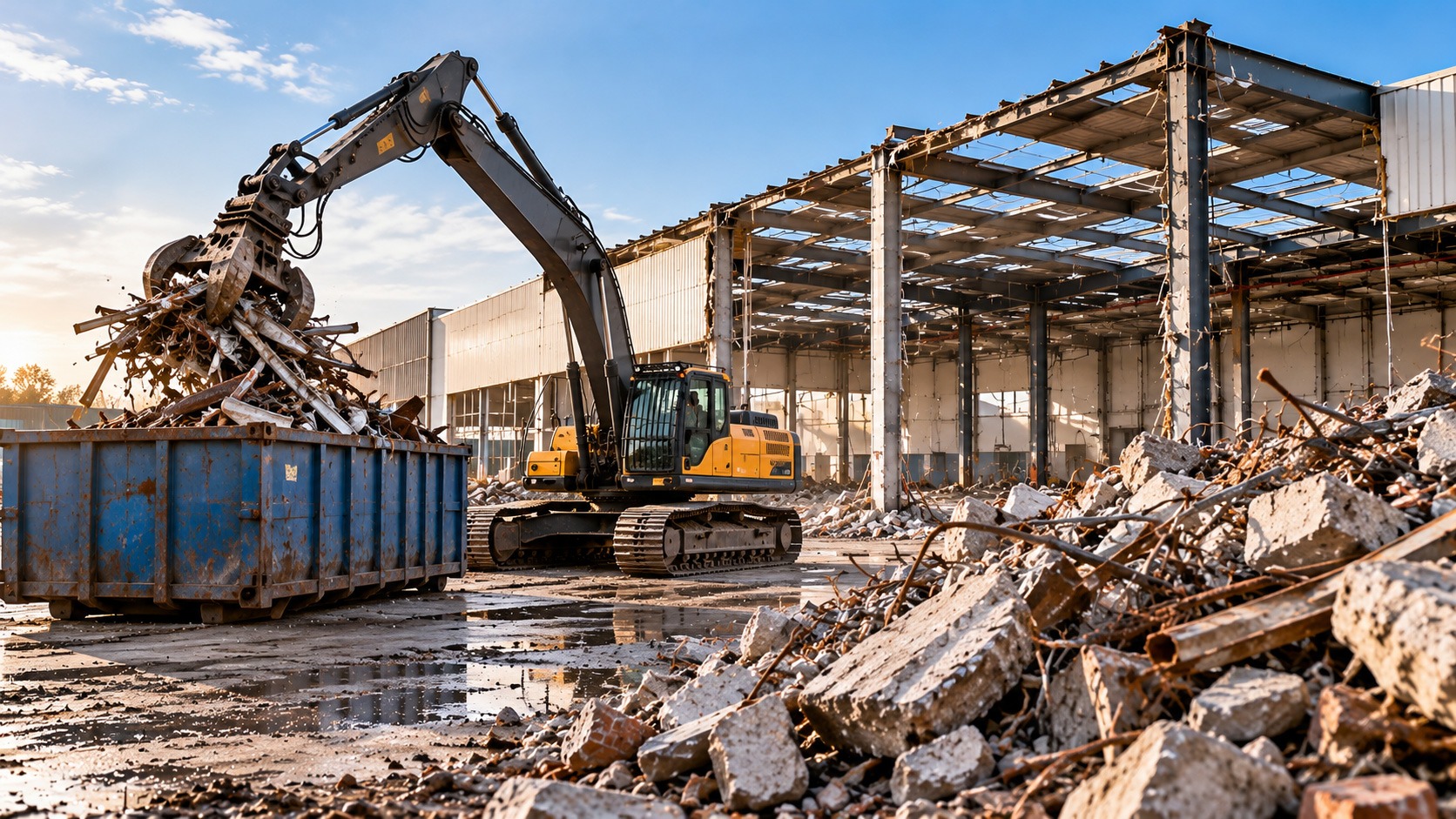
Commercial demolition costs vary considerably depending on the building, the work involved and the condition in which the site needs to be handed over. Removing a small commercial structure is very different from demolishing a large warehouse, dismantling an industrial facility or clearing a site containing heavy machinery.
For developers, principal contractors and commercial property owners, understanding what affects the price is an important first step when planning a demolition project.
HIR Ltd provides commercial and industrial demolition services alongside strip outs, machinery removal, heavy lifting, site and factory clearance and scrap metal recycling. These related services can all influence the scope and cost of a project.
In this guide, we explain the main factors that affect commercial demolition costs in the UK, what a quotation should cover and how to prepare for an initial discussion with a demolition contractor.
How Much Does Commercial Demolition Cost?
There is no single price that applies to every commercial demolition project. The cost depends on the building’s size and construction, the demolition method, site access, surveys, hazardous materials, waste management and the work required after the structure has been removed.
For example, a project involving a straightforward structure with good access may have very different requirements from an industrial building containing heavy plant, complex steelwork or materials that need specialist handling.
A reliable quotation needs to reflect the actual site and scope of works rather than relying on a generic price per square metre.
When requesting a commercial demolition quotation, it helps to establish whether the price includes:
- The agreed demolition and dismantling work
- Required machinery, equipment and labour
- Preliminary site preparation within the contractor’s scope
- Removal and management of demolition materials
- Waste transport, treatment or disposal where included
- Scrap metal recovery arrangements, where applicable
- Site clearance and the agreed handover condition
- Any exclusions, assumptions or additional costs
The important distinction is between the cost of demolishing the structure and the total cost of preparing the site for its next use.
What Affects Commercial Demolition Costs?
Several factors can have a significant impact on the price of a commercial demolition project. Understanding these early helps when preparing a budget and comparing quotations.
1. Building Size and Construction
The size of the building is an obvious consideration, but it is not the only one.
A building’s construction, height, structural arrangement and condition can all affect the resources and methods required. Reinforced concrete, steel-framed structures and buildings with unusual structural features may present different challenges from other types of construction.
The scope also matters. A project involving the complete removal of a building will generally require different work from one involving only selected structures or sections.
Providing plans, approximate dimensions and photographs can help a contractor understand the building before carrying out a more detailed assessment.
2. Site Access and Surrounding Properties
Access can influence how demolition work is carried out.
A site with sufficient space for machinery, vehicles and material handling may be easier to organise than a property with restricted access or limited room for equipment.
The contractor may also need to consider:
- Nearby buildings and boundaries
- Shared access routes
- Public roads and pedestrian areas
- Vehicle loading and collection arrangements
- Restrictions on working hours
- The presence of neighbouring businesses or occupied premises
Where a building sits within an established commercial area, additional planning may be required to manage the work and minimise disruption.
These factors should be assessed for the actual site rather than assumed from the location alone.
3. Full Demolition or Partial Demolition
The amount of the structure being removed has a direct bearing on the scope.
Full demolition involves removing the building or structure within the agreed boundaries. Partial demolition may require selective removal while protecting parts of the building that are to remain.
Partial demolition can require careful sequencing and protection measures, particularly where the retained structure must continue to serve a purpose.
The quotation should make clear which elements are included, what must remain and what condition the building or site should be in when the work is complete.
4. Surveys and Hazardous Materials
Before demolition begins, the building and site may require surveys and specialist assessments.
These can include structural assessments, checks for existing services and surveys for asbestos or other hazardous materials, depending on the property and proposed work.
If hazardous materials are identified, the necessary specialist arrangements may affect both the cost and programme.
It is important to establish who is responsible for arranging surveys, dealing with identified materials and providing the relevant information before demolition starts.
Do not assume that these activities are included in a demolition quotation. Check the scope and exclusions carefully.
5. Machinery, Plant and Internal Installations
Commercial and industrial buildings may contain machinery, production equipment, plant rooms, steelwork and other installations that need to be removed.
Some items may be dealt with during demolition, while others may need to be dismantled, lifted or removed separately.
This can affect the sequence of work and the equipment required.
For projects involving substantial machinery, it is worth discussing removal requirements before the demolition programme is finalised. Identifying what needs to be retained, recovered or removed can help establish a more accurate scope.
HIR Ltd provides machinery removal and heavy lifting services that may support suitable industrial projects.
6. Waste Management and Material Removal
Demolition generates materials that must be handled and managed appropriately. The amount, type and classification of the materials will affect the arrangements required.
The project may involve concrete, masonry, timber, metals and other materials, with different requirements for segregation, transport, recovery or disposal.
When comparing quotations, establish whether the following are included:
- Loading and removing demolition materials
- Waste transport and applicable disposal or treatment charges
- Segregation of different material types
- Recovery of suitable scrap metal
- Final clearance of the agreed work area
A lower initial quotation may not represent the lowest overall cost if substantial removal or clearance work is excluded.
HIR Ltd offers site and factory clearance and scrap metal recycling services that can support suitable commercial and industrial projects.
7. Project Timescale and Working Restrictions
The required programme can also affect the cost.
Some projects have a flexible completion date, while others must be completed before a lease expires, a new contractor arrives or redevelopment work begins.
A restricted programme may require more detailed coordination, changes to working arrangements or additional resources, depending on the project.
Before requesting a quotation, explain the target start date, required completion date and any restrictions on when work can take place.
A realistic programme should account for preliminary assessments, site preparation, demolition, material removal and handover rather than considering the physical demolition in isolation.
Does a Commercial Strip Out Cost Less Than Demolition?
Not necessarily in every situation, but a strip out and a full demolition are different types of work and should not be compared as if they were interchangeable.
A commercial strip out generally involves removing internal fixtures, fittings and non-structural elements while retaining the main building structure. Full demolition involves removing the structure itself, either completely or within the agreed scope.
The cost of each depends on the amount of work, access, materials, specialist requirements and the intended outcome.
A strip out may be appropriate when a building is being refurbished or prepared for a new fit-out. Demolition may be necessary when the structure itself needs to be removed.
Some redevelopment projects require both activities, with internal clearance taking place before structural demolition or other construction work begins.
If you are unsure which service your project requires, see our guide to Strip Out vs Demolition: What’s the Difference?
You can also visit our Commercial Strip Outs service page for more information about internal clearance work.
How Do Industrial Demolition Costs Differ?
Industrial demolition can involve additional requirements that are less common in straightforward commercial building projects.
Factories, warehouses and industrial facilities may contain heavy machinery, plant, specialist installations and substantial steel structures. These can require separate dismantling or removal arrangements before or during demolition.
Other considerations may include:
- The size and complexity of the industrial structure
- Machinery that needs to be removed separately
- Access for lifting equipment and vehicles
- The presence of redundant plant and installations
- The volume and type of materials generated
- Requirements for site clearance and handover
Where several services are needed, it is useful to establish the complete scope before the work is priced.
HIR Ltd provides commercial and industrial services including demolition, strip outs, machinery removal, heavy lifting, site clearance and scrap metal recycling. Depending on the project, these capabilities may help coordinate related removal activities within the wider programme.
The appropriate services and methods will depend on the specific site and requirements.
Can Scrap Metal Recovery Affect Demolition Costs?
Potentially, yes, but the effect depends on the materials involved and the agreed commercial arrangements.
Industrial demolition may produce recoverable metal from structures, machinery and other equipment. Where suitable material can be recovered, its handling and recycling arrangements may form part of the project plan.
However, the presence of scrap metal does not automatically mean that it will offset a particular amount of demolition cost. The type, quantity, condition and value of the material, together with the work needed to recover it, all matter.
When discussing a project, ask how scrap metal and other recoverable materials will be handled and whether the quotation includes any associated recovery arrangements.
HIR Ltd provides scrap metal recycling alongside its commercial and industrial services. Where relevant, material recovery can be discussed as part of the overall project requirements.
What Should a Commercial Demolition Quotation Include?
A useful quotation should make it clear what the contractor has priced and what remains the client’s responsibility.
Before accepting a quotation, check that it explains the main work included and identifies significant exclusions or assumptions.
Consider the following checklist:
- Scope of work: Which structures and elements are to be removed?
- Site preparation: What preliminary activities are included?
- Surveys and specialist work: Who arranges and pays for these?
- Machinery and equipment: Are dismantling and separate removal included where required?
- Waste management: What transport, treatment, disposal or recovery arrangements are covered?
- Site clearance: What condition will the site be left in?
- Programme: What start date and completion assumptions have been made?
- Access and restrictions: Have relevant site limitations been considered?
- Exclusions: Which activities or costs are not included?
- Changes to the scope: How will additional work be assessed and agreed?
Comparing quotations on a like-for-like basis makes it easier to understand the proposed cost and identify differences in the work included.
The cheapest initial figure may not be the most appropriate option if important elements of the project have been left out.
How to Prepare for a Demolition Quote
You do not need every detail finalised before contacting a contractor, but having some basic information ready can make the initial discussion more productive.
Try to provide:
The site location: Include the full address and any access information you already know.
The building type: Explain whether it is an office, retail property, warehouse, factory or another commercial or industrial structure.
The proposed scope: State whether you need full demolition, partial demolition, internal strip out or the removal of specific structures.
The approximate size: Plans, dimensions or a reasonable estimate can help explain the scale of the work.
Photographs and drawings: These can help illustrate the building, access and areas requiring removal.
Machinery details: If the property contains plant or equipment, identify what needs to be removed separately.
Your programme: Explain your target start date, completion deadline and any restrictions on working hours.
Available surveys: Share relevant reports or information about existing services and hazardous materials where available.
A site visit or further assessment may be necessary before a detailed quotation can be prepared.
Commercial Demolition Across London and the Surrounding Areas
HIR Ltd provides commercial and industrial demolition services across London and the surrounding areas.
Our wider capabilities include strip outs, machinery removal, heavy lifting, site and factory clearance and scrap metal recycling. These services may be relevant where a project involves more than the removal of a building alone.
If you are planning demolition at a commercial property, warehouse, factory or industrial site, we can discuss the scope, the site conditions and the related work that may be required.
Explore our Demolition service page for an overview of our capabilities, or visit Demolition London for information about our wider service coverage.
Frequently Asked Questions
How much does commercial demolition cost per square metre?
There is no reliable single rate that applies to every commercial building. Costs depend on the building’s construction, the extent of demolition, access, hazardous materials, machinery removal, waste management and the required handover condition. A project-specific assessment is needed for a meaningful quotation.
What is usually included in a demolition quotation?
A quotation may cover the agreed demolition work, labour, machinery and specified material removal. However, surveys, hazardous-material removal, utility disconnections, waste charges and final site clearance may be treated differently between contractors. Always check the written scope and exclusions.
Do I need permission to demolish a commercial building?
Requirements depend on the building, location and extent of the work. Planning, building control and other legal requirements should be checked with the relevant authorities before work starts. Responsibility for obtaining permissions and serving any required notices should be agreed between the parties involved.
Does asbestos increase demolition costs?
If asbestos or other hazardous materials are present, specialist surveys, removal or other controls may be necessary. These requirements can affect the project cost and programme. The arrangements depend on the materials identified and the applicable requirements.
Can machinery be removed before demolition?
Yes, where the project requires it. Machinery may need separate dismantling, lifting or removal before structural demolition can proceed. The equipment, access arrangements and sequence of work should be assessed in advance.
Can demolition and site clearance be arranged together?
They can be planned as part of the same overall project, subject to the agreed scope and contractor arrangements. It is important to establish whether the quotation covers material removal and the required final site condition.
How do I get a commercial demolition quote from HIR Ltd?
Call HIR Ltd on 0208 166 1221 or email info@hirltd.co.uk. Provide the site address, building type, scope of work and target dates. Plans, photographs and relevant surveys can help the initial discussion.
Request a Commercial Demolition Quotation
Understanding the factors that affect demolition costs helps you plan the project, compare quotations and identify potential requirements before work begins.
HIR Ltd supports commercial and industrial clients with demolition, strip outs, machinery removal, heavy lifting, site clearance and scrap metal recycling across London and the surrounding areas.
If you are planning a demolition project, contact our team to discuss the site, the work required and your proposed timescale.
Our related services include:
- Commercial & Industrial Dilapidations
- Warehouse Dilapidations
- Commercial Dilapidations
- Industrial Dilapidations
- Office Dilapidations
- End of Lease Strip Outs
- Property Reinstatement Services
- Strip Out Services
- Site & Factory Clearance
📞 Call: 0208 166 1221
📧 Email: info@hirltd.co.uk
📍 Based near Heathrow, operating nationwide – including Slough, Chiswick, Hounslow, Middlesex, Richmond, Wembley, Windsor, Woking, Twickenham and Staines
👉 Call HIR Ltd today on 0208 166 1221 to discuss your project or request a free quotation.
