
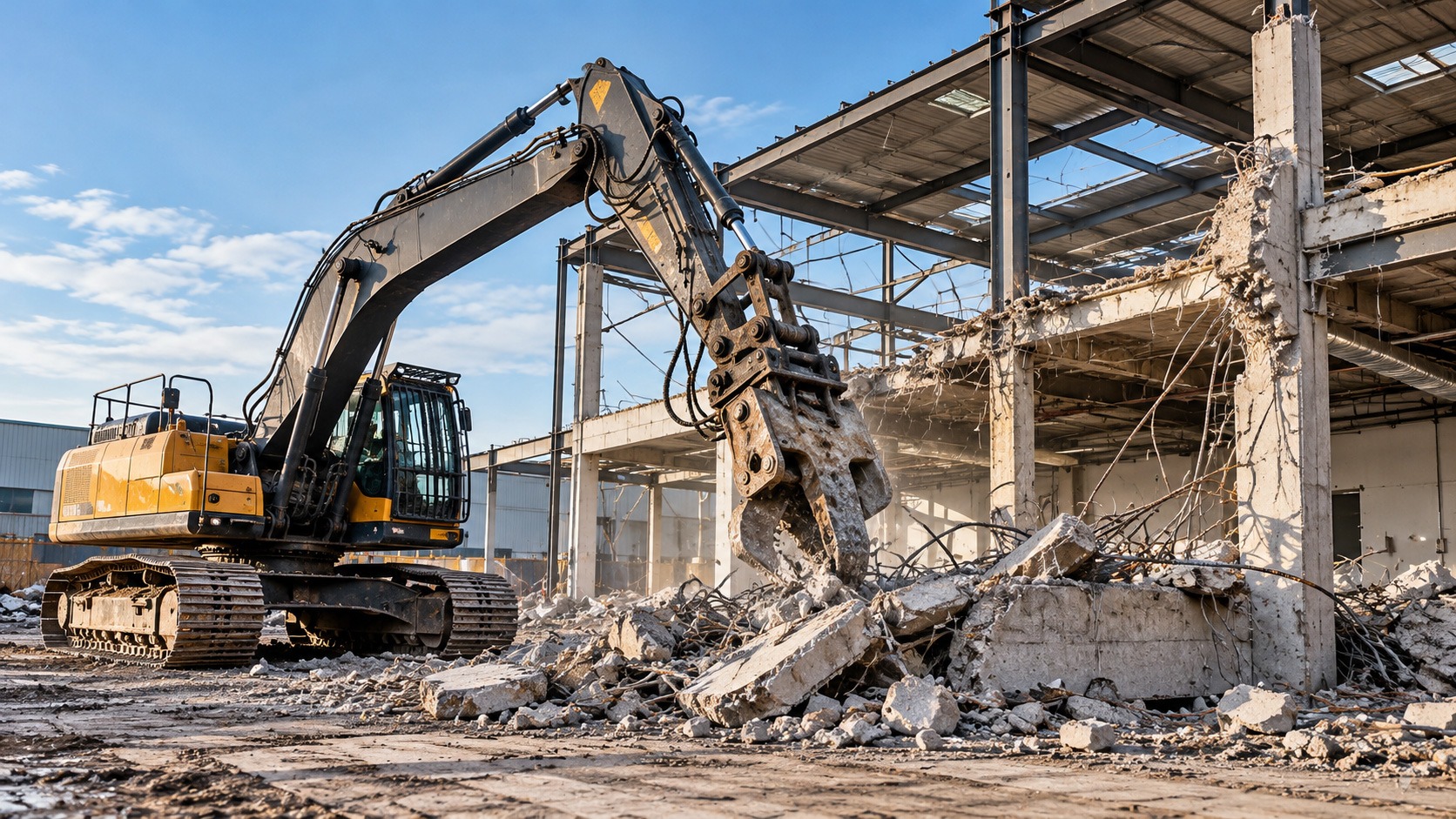
Demolishing a commercial building involves more than bringing down the structure. Before work begins, the site needs to be assessed, the scope agreed and arrangements made for removing equipment, managing materials and coordinating the next stage of the project.
For developers, principal contractors and commercial property owners, getting this preparation right can help avoid delays and reduce the risk of unexpected problems once work starts.
HIR Ltd provides commercial and industrial demolition, strip outs, machinery removal and site clearance services across London and the surrounding areas. Understanding how these activities fit together is an important part of planning a demolition project.
This guide explains what businesses should consider before demolishing a commercial building, from initial surveys to the final site handover.
1. Establish Exactly What Needs to Be Demolished
The first step is to define the scope of the project.
Some buildings need to be removed completely. Others may require partial demolition, with certain structures retained for refurbishment or redevelopment. In industrial premises, the work may also involve dismantling internal installations or removing redundant machinery before structural demolition begins.
The project team should establish:
- Which buildings or structures need to be removed
- Whether demolition will be full or partial
- Which internal elements need to be stripped out first
- Whether machinery, plant or equipment needs separate removal
- What must remain in place and be protected
- What condition the site needs to be in when the work is complete
A clear scope gives the demolition contractor a better understanding of the work involved and helps identify any activities that need to be completed beforehand.
It also helps prevent confusion between demolition, internal strip outs and the removal of equipment. Although these activities can form part of the same project, they may require different methods and sequences.
2. Arrange the Necessary Surveys and Assessments
A building should not be treated as ready for demolition simply because it is empty.
The structure, existing services and any potentially hazardous materials need to be considered before the work begins. The assessments required will depend on the building’s condition, previous use and proposed demolition method.
Asbestos and hazardous materials
Buildings constructed or refurbished in earlier decades may contain asbestos-containing materials. Where asbestos is present or suspected, appropriate surveys and assessments are required before demolition work proceeds.
Other site-specific hazards may also need investigation.
These matters should be identified early enough for the necessary specialist work to be arranged before the demolition programme starts.
Structural condition
The building’s construction and condition influence how it can be dismantled or demolished. Structural information and suitable assessments help inform the proposed demolition method.
The contractor needs to understand which elements are load-bearing, how the structure is supported and whether any unusual features could affect the sequence of work.
Existing services
Electricity, gas, water and other services need to be identified and managed appropriately. The arrangements for isolation, disconnection and verification should be agreed with the relevant parties before demolition begins.
The key point: surveys and assessments should inform the demolition plan, rather than being treated as paperwork to complete at the last minute.
3. Check Planning, Building Control and Other Requirements
Before a commercial demolition project begins, the client and project team should establish which permissions, notices and other legal requirements apply.
These requirements can vary according to the building, its location and the extent of the proposed work.
Depending on the project, checks may include:
- Whether planning permission or other consent is required
- Whether a demolition notice must be served on the relevant local authority
- Whether the building is listed or subject to conservation restrictions
- Whether party wall matters or neighbouring property issues need addressing
- What building control requirements apply
- Whether any environmental or other site-specific restrictions need to be considered
In England and Wales, section 80 of the Building Act 1984 includes requirements relating to notice of proposed demolition, subject to the legislation and applicable exceptions. The relevant local authority should be consulted to establish what applies to the particular project.
Responsibility for obtaining permissions and serving notices should be clearly allocated between the client, principal contractor and other appointed parties.
Leaving these checks until the intended start date can affect the programme, so they should be addressed during the early planning stages.
4. Plan Access and the Demolition Programme
Site access can have a significant influence on how a demolition project is organised.
A large industrial site with open access presents different challenges from a commercial property surrounded by occupied buildings or located on a restricted road.
Before work starts, the project team should consider:
- Access for demolition machinery and vehicles
- Space for loading and removing materials
- The location of neighbouring buildings and public routes
- Any restrictions on vehicle movements or working hours
- How other contractors will access the site
- The expected start date and completion deadline
Where the building is still occupied, arrangements may be needed for staff to leave, equipment to be relocated and the work area to be secured before demolition can proceed.
The demolition programme should also account for the activities that follow. If groundworks or new construction are scheduled immediately afterwards, the handover requirements need to be agreed in advance.
5. Decide Whether Internal Strip Outs Are Needed First
Not every demolition project starts with the removal of the building itself.
In some cases, the interior needs to be cleared before structural demolition can begin. This may involve removing fixtures, fittings, partitions, redundant installations or other elements identified in the project scope.
This process is often known as a soft strip out.
For commercial and industrial buildings, internal clearance may also be required to remove equipment or separate materials before the main demolition works proceed.
The correct sequence depends on the building, the demolition method and the items that need to be retained or recovered.
HIR Ltd provides commercial and industrial strip-out services that can support projects where internal clearance is required before further work begins.
If you are unsure whether your project needs a strip out or demolition, read our related guide: Strip Out vs Demolition: What’s the Difference?
6. Consider Machinery and Plant Removal
Industrial premises can contain machinery and equipment that cannot simply be treated as general demolition material.
Production lines, large plant, steel installations and other equipment may need to be dismantled, lifted or removed separately. This work needs to be considered alongside the demolition programme.
Before work begins, establish:
- Which equipment is to be retained, sold or removed
- Whether machinery needs dismantling before removal
- The weight and dimensions of larger items
- Whether there is sufficient access for removal
- What lifting equipment or specialist resources may be required
- How equipment removal fits into the demolition sequence
Removing machinery at the appropriate stage can help avoid unnecessary handling and prevent equipment from obstructing subsequent work.
HIR Ltd provides machinery removal and heavy lifting services alongside its wider commercial and industrial capabilities. These services can be relevant where equipment removal forms part of a larger demolition or site clearance project.
The method and resources required will depend on the specific equipment and site conditions.
7. Plan for Demolition Waste and Material Recovery
Demolition generates materials that need to be handled, segregated and removed appropriately.
The type and quantity of material will depend on the building and the agreed scope. A project may produce concrete, masonry, timber, metals and other materials, each with its own handling and disposal or recovery requirements.
Planning should establish:
- How demolition materials will be separated
- How materials will be stored and removed from the site
- Which materials may be suitable for recovery or recycling
- How waste will be classified and managed
- What documentation is required
- What condition the site must be left in
Metal recovery can be particularly relevant to industrial demolition, where redundant machinery, steelwork and other metal components may be present.
HIR Ltd provides scrap metal recycling and site clearance services that can support suitable commercial and industrial projects.
The appropriate arrangements depend on the materials involved, their condition and classification, and the requirements of the project. Recovery and recycling should be considered as part of the overall plan rather than left until demolition is complete.
8. Coordinate the Demolition Contractor With Other Trades
Demolition often forms one part of a larger construction or redevelopment programme.
The work may need to be coordinated with surveyors, utility providers, asbestos specialists, waste contractors, groundworkers and the team responsible for the next stage of construction.
Clear responsibilities help establish who is responsible for each activity and when it needs to be completed.
Before work begins, the project team should agree:
- The scope of the demolition contractor’s work
- Which preliminary activities must be completed
- Who is responsible for surveys and permissions
- How site access and working areas will be managed
- How changes to the scope will be communicated
- What is required for completion and handover
A demolition contractor should have the information needed to understand the site and the intended outcome. Any changes to the building, programme or scope should be communicated before they affect the planned work.
9. What Information Does a Demolition Contractor Need for a Quote?
The more information available at the enquiry stage, the easier it is to establish the likely scope of the project.
You do not necessarily need every document ready before making an initial enquiry, but the following information is useful.
| Information | Why it matters |
|---|---|
| Site address | Establishes the location and initial access considerations |
| Building type and approximate size | Helps describe the scale of the work |
| Scope of demolition | Clarifies whether the requirement is full demolition, partial demolition or internal clearance |
| Photographs and plans | Help explain the building and the work involved |
| Existing surveys | May identify structural, asbestos or other relevant considerations |
| Machinery and equipment details | Helps identify any separate removal or lifting requirements |
| Site access information | Highlights restrictions that could affect the programme |
| Target dates | Helps establish the proposed timetable |
| Handover requirements | Clarifies what needs to be completed before the next stage |
A site visit or further assessment may be required before a detailed quotation can be prepared.
Providing a clear description at the outset helps the contractor identify the main requirements and any information still needed.
10. Choosing a Commercial Demolition Contractor
The right contractor should be able to understand the project scope, identify practical constraints and explain how the proposed work relates to the wider programme.
When comparing contractors, consider their relevant experience, the resources required for your project, the proposed approach to safety and the arrangements for handling demolition materials.
It is also worth establishing whether the contractor can support related work such as internal strip outs, machinery removal and site clearance.
Where several activities are required, understanding how they will be coordinated can help when planning the overall project.
HIR Ltd provides commercial and industrial demolition and related services across London and the surrounding areas. Our wider capabilities include strip outs, machinery removal, heavy lifting, site and factory clearance and scrap metal recycling.
To discuss a project, contact our team with the site location, a description of the work and your intended programme.
Frequently Asked Questions
What needs to happen before a commercial building can be demolished?
The project team should establish the scope, assess the building and existing services, arrange any necessary surveys, check applicable permissions and notices, and plan access, safety measures and material removal. The exact requirements depend on the property and the proposed work.
Is planning permission always required for demolition?
Not every demolition project follows the same permission process. Requirements depend on the building, location, extent of demolition and applicable legislation. The client and project team should check with the relevant local planning authority and building control body before work begins.
Does a building need an asbestos survey before demolition?
Where asbestos may be present, the appropriate surveys and assessments must be undertaken before demolition proceeds. The type of survey required depends on the building and the planned work. Suspected asbestos should be dealt with through the appropriate specialist process.
Should a building be stripped out before demolition?
That depends on the demolition method and the agreed scope. Some projects require internal elements, machinery or selected materials to be removed first. In other cases, the planned demolition method may account for these elements differently.
Can machinery be removed before an industrial building is demolished?
Yes, machinery removal may be arranged before demolition where the equipment needs to be retained, recovered or removed separately. The sequence depends on the equipment, access, lifting requirements and demolition plan.
What happens to materials after demolition?
Materials must be managed in accordance with their classification and applicable waste requirements. Depending on their type and condition, they may be sent for recovery, recycling or appropriate disposal. These arrangements should be included in the project plan.
How long does commercial demolition take?
The timescale depends on the size and construction of the building, the demolition method, surveys, permissions, access and the amount of material to be removed. A realistic programme can be established once the scope and site conditions have been assessed.
How do I arrange a commercial demolition quotation?
Contact HIR Ltd on 0208 166 1221 or email info@hirltd.co.uk. Provide the site address, building type, proposed scope and target dates. Photographs, plans and available survey information can also help the initial discussion.
Planning a Commercial or Industrial Demolition Project?
Getting the preparation right helps establish a clearer scope, identify potential constraints and coordinate demolition with the next stage of work.
HIR Ltd supports commercial and industrial projects with demolition, strip outs, machinery removal, heavy lifting, site clearance and scrap metal recycling across London and the surrounding areas.
If you are planning a demolition project, contact our team to discuss the building, the work required and your intended programme.
Our related services include:
- Commercial & Industrial Dilapidations
- Warehouse Dilapidations
- Commercial Dilapidations
- Industrial Dilapidations
- Office Dilapidations
- End of Lease Strip Outs
- Property Reinstatement Services
- Strip Out Services
- Site & Factory Clearance
📞 Call: 0208 166 1221
📧 Email: info@hirltd.co.uk
📍 Based near Heathrow, operating nationwide – including Slough, Chiswick, Hounslow, Middlesex, Richmond, Wembley, Windsor, Woking, Twickenham and Staines
👉 Call HIR Ltd today on 0208 166 1221 to discuss your project or request a free quotation.
