
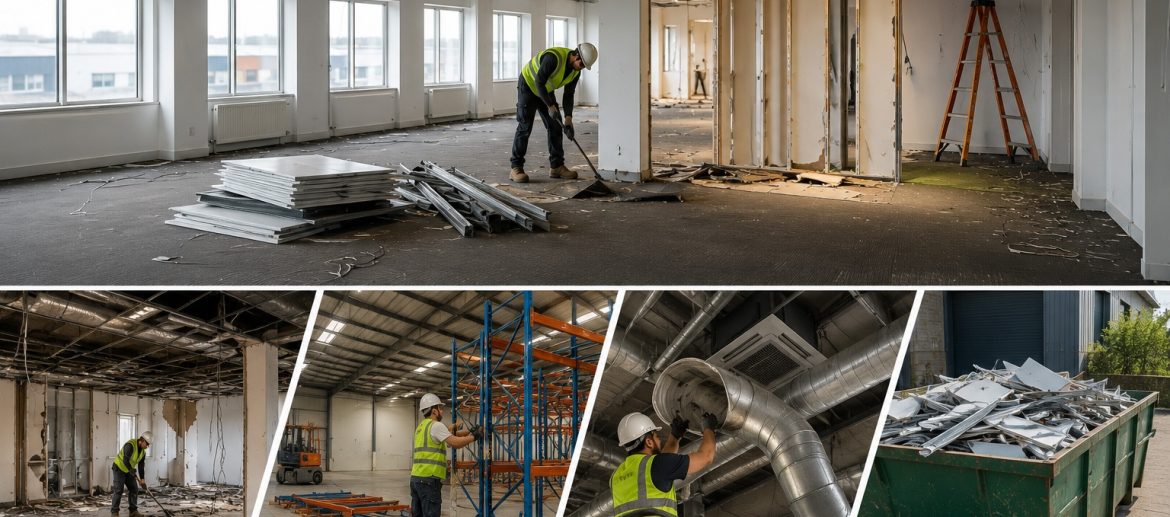
End of Lease Strip Out Contractors
When a commercial lease comes to an end, tenants may be required to remove alterations, fixtures and installations they have introduced during their occupation.
This can turn a straightforward move into a much larger project.
End of lease strip outs involve the planned removal of tenant-installed items and internal alterations before commercial premises are handed back to the landlord.
HIR Ltd provides professional lease exit strip out services for offices, retail units, industrial properties, warehouses and other commercial premises across London and the South East.
From removing office partitions and shop fittings to dismantling warehouse racking and industrial installations, we can manage the physical strip out work required as part of your property exit.
What Is an End of Lease Strip Out?
An end of lease strip out is the physical removal of tenant-installed fixtures, fittings, alterations and other items that need to be removed before a commercial property is returned.
The exact requirements vary between leases and properties.
Examples can include:
- Office partitions
- Raised flooring
- Suspended ceilings
- Bespoke reception areas
- Shop fittings
- Display systems
- Warehouse racking
- Mezzanine structures
- Machinery installations
- Internal signage
- Kitchens
- Lighting
- Data cabling
- Air conditioning
- Ventilation systems
- Built-in storage
The work may form part of a broader lease exit, dilapidation or reinstatement project.
Why Do Tenants Need Strip Out Work?
Businesses often make substantial changes to commercial premises during a tenancy.
An office may be divided into meeting rooms. A retailer may install a complete shop fit-out. An industrial tenant may introduce machinery, racking or specialist services.
When the lease ends, the landlord may require some or all of those alterations to be removed.
This means the tenant could be responsible for returning the premises in a different condition from how it operated during the tenancy.
The precise obligations depend on the individual lease and associated documentation, so the required works should be established before removal begins.
What Can Be Removed Before Lease Expiry?
The scope of an end of lease strip out depends entirely on the property and the tenant’s obligations.
Office Lease Exit Strip Outs
Typical works can include:
- Partition walls
- Meeting rooms
- Reception desks
- Built-in storage
- Kitchens
- Raised floors
- Suspended ceilings
- Data cabling
- Lighting
- Air conditioning
Retail Lease Exit Strip Outs
Retailers may need to remove:
- Shop counters
- Display units
- Shelving
- Changing rooms
- Signage
- Branding
- Feature walls
- Lighting
- Back-of-house fittings
Warehouse Lease Exit Strip Outs
Warehouse tenants may have installed:
- Pallet racking
- Shelving
- Mezzanine floors
- Conveyor systems
- Warehouse offices
- Storage cages
- Handling equipment
These installations may need to be dismantled and removed before the property is handed back.
Industrial Lease Exit Strip Outs
Industrial premises can contain much heavier and more complex installations.
Potential removal work includes:
- Machinery
- Production equipment
- Extraction systems
- Industrial pipework
- Workstations
- Storage systems
- Mezzanine structures
- Specialist services
Where heavy equipment is involved, additional dismantling and lifting requirements may need to be considered.
End of Lease Strip Out vs Dilapidations
End of lease strip out describes the physical removal work required to clear tenant alterations and installations.
Dilapidations concerns the condition and lease obligations associated with returning the property.
Reinstatement describes the work required to restore the affected areas.
A lease exit could therefore involve all three.
Example
A tenant has installed partition walls in an office.
Lease requirement:
The tenant needs to remove the partitioning.
Strip out:
HIR Ltd dismantles and removes the partitions.
Reinstatement:
The affected floor, walls and ceiling are repaired or made good as required.
This distinction allows the different HIR services to work together without competing for exactly the same search intent.
When Should You Start Planning an End of Lease Strip Out?
Leaving a commercial property can involve considerably more work than moving furniture and equipment.
It is therefore worth establishing the likely strip out requirements well before the lease expiry date.
Early planning allows time to:
- Review the lease requirements
- Establish the scope of removal
- Identify retained items
- Arrange access
- Plan dismantling
- Coordinate waste removal
- Schedule specialist equipment
- Complete reinstatement
- Address unexpected issues
Starting early also reduces the risk of discovering additional work immediately before the handover deadline.
Reviewing the Property Before the Strip Out
Before removal begins, the scope should be clearly established.
This can involve identifying:
Tenant alterations
What has the tenant changed since taking occupation?
Existing fixtures
Which items were already present when the lease began?
Items to remain
What does the landlord expect to stay?
Items to remove
Which tenant installations need to be dismantled?
Areas requiring reinstatement
What damage or alterations will remain after removal?
This process helps prevent unnecessary removal of items that should remain within the property.
End of Lease Strip Out Process
While every project is different, a typical process can involve several stages.
1. Establish the Scope
The items requiring removal are identified and agreed.
2. Plan Access & Programme
The project is scheduled around the building, landlord requirements, access arrangements and lease expiry.
3. Isolate Services
Where required, electrical, mechanical and other services are appropriately isolated before dismantling.
4. Dismantle Tenant Installations
Items are removed systematically rather than simply demolished.
5. Remove Materials
Dismantled materials are taken from the property using the agreed access and removal arrangements.
6. Segregate Waste
Materials suitable for recycling or recovery can be separated from general waste.
7. Final Clearance
The property is left clear of the agreed items and ready for the next stage.
8. Reinstatement
Where required, additional repair and making-good work can follow the strip out.
Removing Tenant Fixtures & Fittings
The term “fixtures and fittings” can cover a wide variety of items in commercial premises.
Depending on the property, these may include:
- Built-in furniture
- Counters
- Storage
- Shelving
- Partitions
- Kitchen units
- Sanitaryware
- Display systems
- Reception areas
- Specialist installations
Not every item should automatically be removed.
The scope should be based on the actual lease requirements and the agreed handover condition.
End of Lease Strip Outs & Office Partitions
Office partitioning is one of the most common examples of a tenant alteration.
A business may have transformed an open-plan floor into:
- Private offices
- Meeting rooms
- Boardrooms
- Reception areas
- Breakout spaces
- Staff facilities
If those alterations need to be removed, the strip out can include the partition systems and associated flooring, ceiling and electrical elements where required.
End of Lease Strip Outs & Warehouse Racking
Warehouse tenants frequently install storage infrastructure to suit their operations.
This can include extensive pallet racking and shelving.
When a lease ends, the tenant may need to dismantle and remove these systems.
A warehouse strip out can therefore involve:
- Racking dismantling
- Shelving removal
- Mezzanine removal
- Conveyor removal
- Storage system clearance
- Metal recycling
End of Lease Strip Outs & Retail Fit-Outs
Retail premises can be particularly heavily customised by tenants.
A retailer may install a complete interior including:
- Shop fittings
- Counters
- Displays
- Changing rooms
- Lighting
- Branding
- Signage
- Back-of-house facilities
Where these installations need to be removed, the strip out must be carefully planned around the property’s access arrangements and handover deadline.
Machinery Removal During Lease Exit
Industrial tenants may have installed machinery that needs to leave the premises.
This can present additional challenges because equipment may be:
- Heavy
- Large
- Fixed to the floor
- Connected to services
- Difficult to access
- Part of a larger production system
Machinery removal can require dismantling, specialist handling and lifting.
HIR Ltd’s wider heavy lifting and machinery removal capabilities can be incorporated where required.
Waste Management & Recycling
Lease exit strip outs can generate substantial quantities of material.
Depending on the property, this could include:
- Steel
- Aluminium
- Copper
- Timber
- Glass
- Electrical equipment
- Flooring
- Ceiling systems
- General construction waste
Where practical, materials can be segregated for recycling and responsible disposal.
This can be particularly valuable on industrial, warehouse and retail projects where significant quantities of metal or reusable materials may be removed.
What Happens After the Strip Out?
Removing the tenant’s installations may be only one part of the lease exit.
The property may also require:
- Repairs
- Making good
- Redecoration
- Floor repairs
- Ceiling repairs
- Removal of fixings
- Restoration of services
This is why it is important to consider the strip out and reinstatement requirements together when planning the project.
Avoiding Last-Minute Lease Exit Problems
One of the biggest risks with a commercial lease exit is leaving the physical work too late.
A project can become more complicated if:
- Access is restricted
- The building has limited loading facilities
- Specialist equipment is required
- Large amounts of waste need removing
- Multiple contractors need coordinating
- Reinstatement work follows the strip out
- The handover date is fixed
Planning the strip out well ahead of the lease expiry can provide more time to resolve unexpected issues.
Working With Landlords & Property Managers
HIR Ltd can work with tenants, landlords, property managers, developers and main contractors during commercial lease exits.
The scope can be coordinated around:
- Landlord access requirements
- Building management procedures
- Handover dates
- Other contractors
- Loading restrictions
- Working hours
- Waste removal
- Retained areas
The objective is to complete the agreed physical removal works efficiently and leave the property ready for the next stage.


End of Lease Strip Out Contractors Across London & the South East
HIR Ltd provides site and factory clearance services across London, Hounslow, Slough, Staines, Chiswick, Middlesex, Surrey, Berkshire and nationwide.
We provide end of lease strip out services throughout:
- London
- Heathrow
- Hounslow
- Slough
- Middlesex
- Richmond
- Twickenham
- Wembley
- Windsor
- Staines
- Woking
- Berkshire
- Surrey
Many of our customers use our A/C removal services as part of site clearance in London, Hounslow, Slough, Staines, Chiswick, Middlesex, Heathrow, Richmond, Wembley, Windsor, Woking, Twickenham.
Frequently Asked Questions – End of Lease Strip Outs
What is an end of lease strip out?
An end of lease strip out involves the physical removal of tenant-installed fixtures, fittings, alterations and other agreed items before commercial premises are handed back to the landlord.
Does every commercial lease require a strip out?
No. The requirements depend on the individual lease, alterations made during the tenancy and the agreed condition for handover.
Is an end of lease strip out the same as dilapidations?
No. A strip out concerns physical removal work, whereas dilapidations relate to obligations concerning the condition and reinstatement of the property.
When should I arrange an end of lease strip out?
Ideally, the requirements should be established well before the lease expiry date. This allows sufficient time for dismantling, clearance, reinstatement and any unexpected work.
Can you remove office partitions at the end of a lease?
Yes. Office partitions are a common type of tenant alteration that may need to be removed as part of a lease exit strip out.
Can you remove warehouse racking?
Yes. Warehouse racking can be dismantled and removed as part of an end of lease strip out where this forms part of the agreed scope.
Can you remove industrial machinery?
Yes, where machinery removal forms part of the project. Heavy or complex equipment may require specialist dismantling, lifting and handling arrangements.
Can you carry out reinstatement after the strip out?
Where required and within the agreed scope, HIR Ltd can support wider property reinstatement requirements following removal works.
Why Choose HIR Ltd for End of Lease Strip Outs?
HIR Ltd has more than 30 years of experience providing commercial and industrial removal, demolition, clearance and specialist contracting services.
Our wider capabilities mean a lease exit project can potentially combine:
- End of lease strip outs
- Commercial dilapidations
- Property reinstatement
- Office strip outs
- Retail strip outs
- Industrial strip outs
- Warehouse strip outs
- Heavy lifting
- Machinery removal
- Site clearance
- Scrap metal recycling
- A/C and chiller disposal
This is particularly useful where the lease exit involves multiple types of removal work.
Related Dilapidation Services
Need End of Lease Strip Out Contractors?
If your commercial lease is coming to an end and tenant alterations need to be removed, HIR Ltd can provide a professionally managed end of lease strip out service.
From office partitions and retail fittings to warehouse racking and industrial installations, we can plan and coordinate the physical removal work around your lease exit and handover requirements.
Call 0208 166 1221 to discuss your project or request a quotation
