
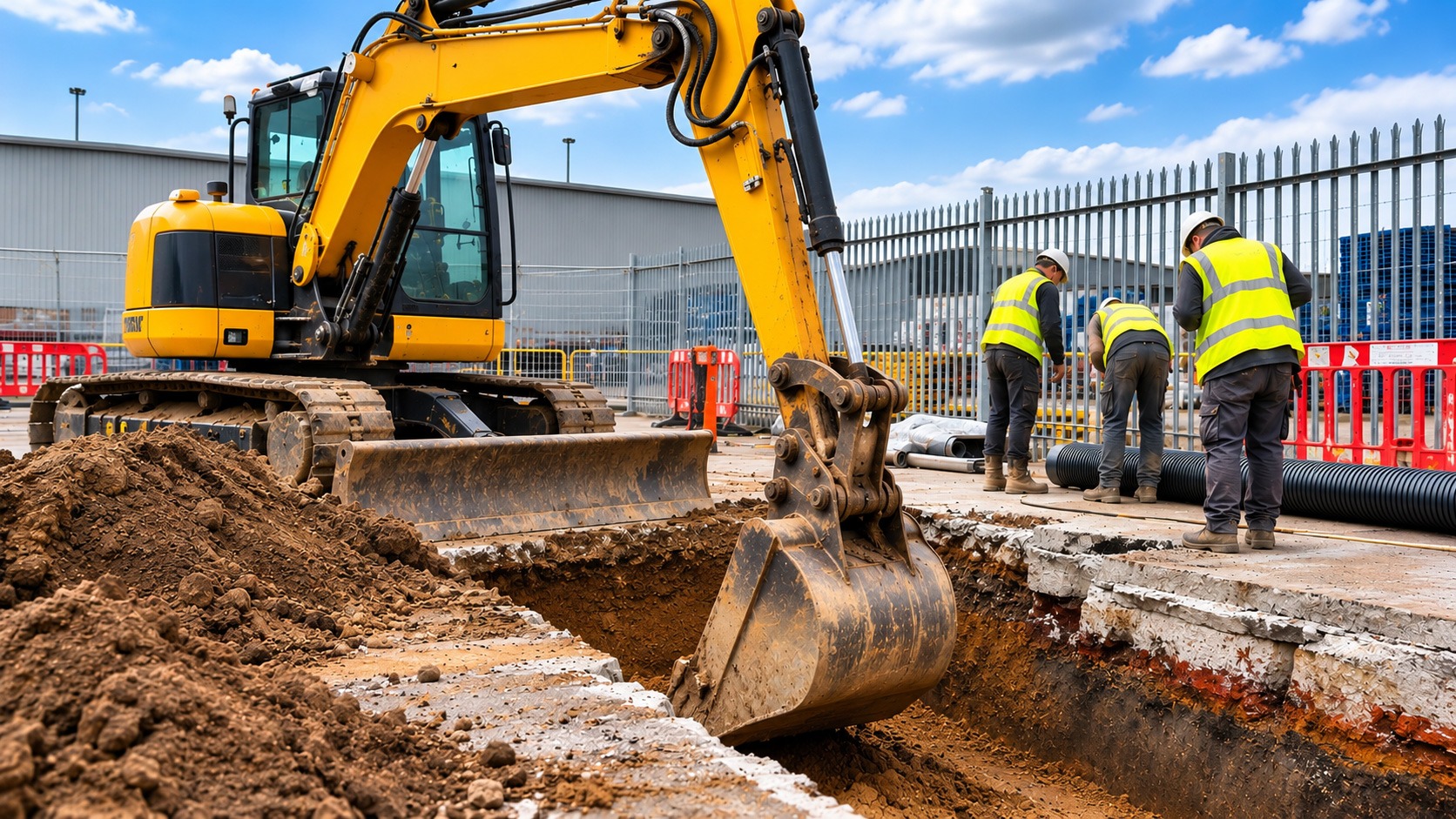
Groundworks are often the part of a construction or redevelopment project that people don’t think about until something needs digging up, moving or putting right.
Whether you’re preparing a commercial site for development, improving an existing drainage system or carrying out essential repairs to an industrial yard, getting the groundwork right is important. Problems below ground can cause delays, additional costs and complications further down the line.
Commercial groundworks cover a much wider range of work than simply excavating soil. They can involve drainage installation, trenching, investigation of existing underground services, concrete works, soakaways and reinstatement of the finished surface.
At HIR Ltd, we undertake commercial and industrial groundworks projects across London, Heathrow, Surrey, Berkshire and the wider UK. In this guide, we’ll explain what’s involved, when you might need a specialist contractor and some of the challenges that can arise during a project.
What Are Commercial Groundworks?
Commercial groundworks are the preparation and construction activities carried out at ground level and below it to support a building, development or existing site.
The exact work depends on the condition of the site and what the client needs to achieve. A project might involve installing a completely new drainage system, excavating trenches for underground pipework or preparing an industrial yard for further construction work.
Unlike smaller domestic jobs, commercial groundworks can involve larger areas, existing infrastructure, buried services and the need to coordinate work around an operational site.
Typical commercial groundworks include:
- Site excavation and earthworks.
- Drainage installation and replacement.
- Trenching for underground services.
- Soakaway construction.
- Ground investigation and preparation.
- Concrete slab installation and reinstatement.
- Tarmac resurfacing.
- Removal and management of unsuitable or contaminated materials.
- General civil engineering and site preparation.
The requirements are different on every site, which is why understanding the existing ground conditions and the work involved is important before excavation begins.
What Services Do Commercial Groundworks Contractors Provide?
A groundworks contractor can provide several services as part of one project. This can be particularly useful when excavation, drainage installation and reinstatement all need to be completed as part of the same package.
1. Excavation and Trenching
Excavation is often the starting point for commercial groundworks. It involves removing existing surfaces and soil to create the space needed for drainage, foundations, underground installations or other construction work.
Trenching is commonly required where new drainage pipes or underground services need to be installed.
The depth, width and route of an excavation will depend on the requirements of the project. Existing services, ground conditions and surrounding structures also need to be considered before work starts.
On established commercial sites, excavation can be more complicated than expected. Previous construction work may have left buried materials, redundant structures or services that aren’t clearly shown on available drawings.
2. Commercial Drainage Installation
Drainage is one of the most important parts of many commercial groundworks projects.
A poorly planned or inadequate drainage system can lead to standing water, flooding, disruption to operations and damage to surrounding surfaces.
Commercial drainage installation can include:
- New underground drainage pipework.
- Replacement of damaged or unsuitable drainage.
- Surface water drainage solutions.
- Inspection pits and associated excavation.
- Connections to existing drainage systems.
- Installation of soakaways.
- Reinstatement following drainage works.
The drainage layout needs to suit the site and its requirements. Pipe sizes, gradients, routes and connections all need to be considered as part of the installation.
For larger projects, it is also important to understand how the proposed drainage route interacts with existing underground services and structures.
3. Soakaway Installation
A soakaway provides a way of allowing collected surface water to drain into the surrounding ground.
They are commonly used as part of surface water management on commercial and industrial sites, although whether a soakaway is suitable depends on the ground conditions, available space and drainage requirements.
Installation generally involves excavation, preparation of the area, construction of the soakaway system and connection to the relevant drainage pipework.
The size and design need to be appropriate for the site. Ground conditions and the ability of water to soak into the surrounding soil are important considerations.
4. Underground Service Investigation
One of the biggest challenges when carrying out groundworks on an existing commercial site is knowing exactly what is below the surface.
Electrical cables, gas pipes, water services and other underground infrastructure may be present, sometimes in locations that aren’t immediately obvious from the available site information.
Before and during excavation, the location of existing services needs careful consideration. Depending on the conditions, this may involve investigation work, inspection pits and controlled hand excavation in sensitive areas.
Finding an unexpected service doesn’t necessarily mean a project has to stop completely, but the work may need to be reassessed before it can safely continue.
5. Concrete and Tarmac Reinstatement
Once excavation and installation work is complete, the affected areas may need to be reinstated.
This is an important part of the overall project, particularly on commercial yards, warehouse entrances, access roads and operational premises.
Reinstatement can involve:
- Preparing the excavated area.
- Reinstating sub-base materials.
- Installing or repairing reinforced concrete slabs.
- Reinstating concrete surfaces.
- Final tarmac resurfacing.
- Clearing the work area ready for use.
Good reinstatement helps return the affected area to a suitable condition for the client’s ongoing operations.
What Can Go Wrong During Commercial Groundworks?
Even with planning and preparation, excavation can uncover problems that weren’t apparent before work started.
This is particularly common on older commercial and industrial sites where the original construction drawings may be incomplete or underground infrastructure has changed over time.
Some of the challenges include:
Unrecorded underground structures
Old tanks, redundant foundations and buried obstructions can affect the planned excavation route. These need to be assessed before deciding how the work should proceed.
Unexpected ground conditions
Different areas of the same site can have different surface finishes, construction layers and ground conditions. This can affect excavation methods and the amount of work required.
Existing underground services
Discovering an electrical cable, gas pipe or other service in an unexpected location can mean the original excavation plan needs to change.
Contaminated materials
Excavation may uncover materials that require further investigation and appropriate handling. Where this happens, work may need to pause while the material is assessed and the correct arrangements are made.
The important thing is how these situations are dealt with. A practical contractor needs to be able to assess what has been found, communicate the implications and work out a suitable way forward.
A Real Commercial Groundworks Project: South Ockendon, London
A good example of the challenges that can arise during commercial groundworks was a recent project undertaken by HIR Ltd for Howard Tenens in South Ockendon.
The project involved installing approximately 55–60 linear metres of new 225mm solid uPVC drainage pipe, constructing a precast concrete soakaway and completing the associated excavation and reinstatement works.
However, the team encountered several unexpected conditions once excavation began.
An undocumented underground tank was discovered that wasn’t shown on the original site drawings. Existing electrical services also required careful hand excavation, while further investigation was needed to locate an existing gas pipe.
The team also encountered low-grade asbestos-contaminated material, requiring additional investigation and a pause while test results were awaited.
Rather than simply continuing with the original drainage layout, HIR assessed the underground obstruction and redesigned the route to divert around the tank. This allowed the installation to proceed without unnecessarily disturbing the existing structure.
The project included:
- Installation of approximately 55–60 metres of 225mm uPVC drainage.
- Construction of a new precast concrete soakaway.
- Excavation and trenching.
- Investigation of existing underground services.
- Management and removal of contaminated material.
- Reinforced concrete slab reinstatement.
- Final tarmac resurfacing and site clearance.
The works were completed between 25 September and 16 October 2026, leaving the affected areas reinstated and ready for use.
Read the full project: Rainham Groundworks & Drainage Installation – South Ockendon
How to Choose a Commercial Groundworks Contractor
Choosing a contractor for commercial groundworks isn’t just about finding someone with the equipment to excavate a site.
You need a team that understands the wider requirements of the job and can deal with the practical issues that arise along the way.
Before appointing a contractor, consider the following:
Experience with commercial and industrial sites
Working on an operational warehouse, factory or industrial yard can involve different challenges to a straightforward excavation project. Look for experience that is relevant to your site and the work required.
Range of services
If your project involves excavation, drainage, waste removal and reinstatement, using a contractor capable of coordinating these elements can simplify the process.
Understanding of existing services
Underground infrastructure needs to be considered carefully. Ask how the contractor approaches service investigations and excavation around existing installations.
Planning and communication
Unexpected findings can affect costs and timescales. You want a contractor who will explain the situation, discuss practical options and keep you informed.
Appropriate waste management
Groundworks can generate excavated materials and waste that need to be handled and disposed of appropriately. Make sure the proposed arrangements are suitable for the materials involved.
What Information Do You Need When Requesting a Groundworks Quote?
Providing the right information at the beginning can help a contractor understand the project and prepare a more accurate quotation.
Where possible, include:
- The site address and type of premises.
- A description of the proposed groundworks.
- Drawings showing the proposed excavation or drainage route.
- Details of existing drainage and underground services.
- Approximate excavation depths and dimensions.
- Information about existing ground or surface conditions.
- Any known contamination or underground obstructions.
- Required completion dates or programme constraints.
- Site access arrangements and any operational restrictions.
You don’t necessarily need every detail before making an initial enquiry. An experienced contractor can discuss the project with you and identify what additional information may be required.
Commercial Groundworks Contractors Across London and the UK
HIR Ltd provides commercial and industrial groundworks, civil engineering and site clearance services for businesses, contractors and commercial property owners.
Our work includes excavation, drainage installation, soakaway construction, groundworks and associated reinstatement.
Based near Heathrow, we support projects across London, Surrey and Berkshire, as well as undertaking work further afield across the UK.
Whether you need a new drainage installation, excavation work at an existing industrial premises or a wider groundworks package, we can discuss the requirements and help establish the right approach.
Frequently Asked Questions
What is included in commercial groundworks?
Commercial groundworks can include excavation, trenching, drainage installation, soakaway construction, underground service investigations, concrete works and site reinstatement. The exact services depend on the project and the condition of the site.
Do groundworks contractors install commercial drainage systems?
Yes. Commercial drainage installation can form part of a wider groundworks package, including excavation, pipework installation, soakaways and reinstatement of affected surfaces.
What is a commercial soakaway?
A commercial soakaway is a drainage feature designed to collect surface water and allow it to disperse into the surrounding ground. Its suitability and design depend on the site’s drainage requirements and ground conditions.
Can groundworks be carried out around existing underground services?
Yes, but the location of existing services must be properly considered. Investigation work, inspection pits and controlled hand excavation may be needed where services are present or their locations are uncertain.
What happens if an underground obstruction is discovered?
The obstruction should be assessed before work continues in the affected area. Depending on what is found, the excavation method or proposed installation route may need to change. HIR encountered this situation during its South Ockendon drainage project, where the route was redesigned to avoid an undocumented underground tank.
Do commercial groundworks include concrete and tarmac reinstatement?
They can. Where excavation affects existing concrete slabs, yards or access roads, reinstatement may be included in the groundworks package to return the area to a suitable condition.
Where does HIR Ltd provide groundworks services?
HIR Ltd supports commercial and industrial projects across London, Heathrow, Surrey, Berkshire and the wider UK. Contact the team to discuss your location and project requirements.
Need Commercial Groundworks or Drainage Installation?
If you’re planning a commercial groundworks project, need drainage installed or require excavation and civil engineering support, speak to HIR Ltd.
Our related services include:
- Commercial & Industrial Dilapidations
- Warehouse Dilapidations
- Commercial Dilapidations
- Industrial Dilapidations
- Office Dilapidations
- End of Lease Strip Outs
- Property Reinstatement Services
- Strip Out Services
- Site & Factory Clearance
📞 Call: 0208 166 1221
📧 Email: info@hirltd.co.uk
📍 Based near Heathrow, operating nationwide – including Slough, Chiswick, Hounslow, Middlesex, Richmond, Wembley, Windsor, Woking, Twickenham and Staines
👉 Call HIR Ltd today on 0208 166 1221 to discuss your project or request a free quotation.
