
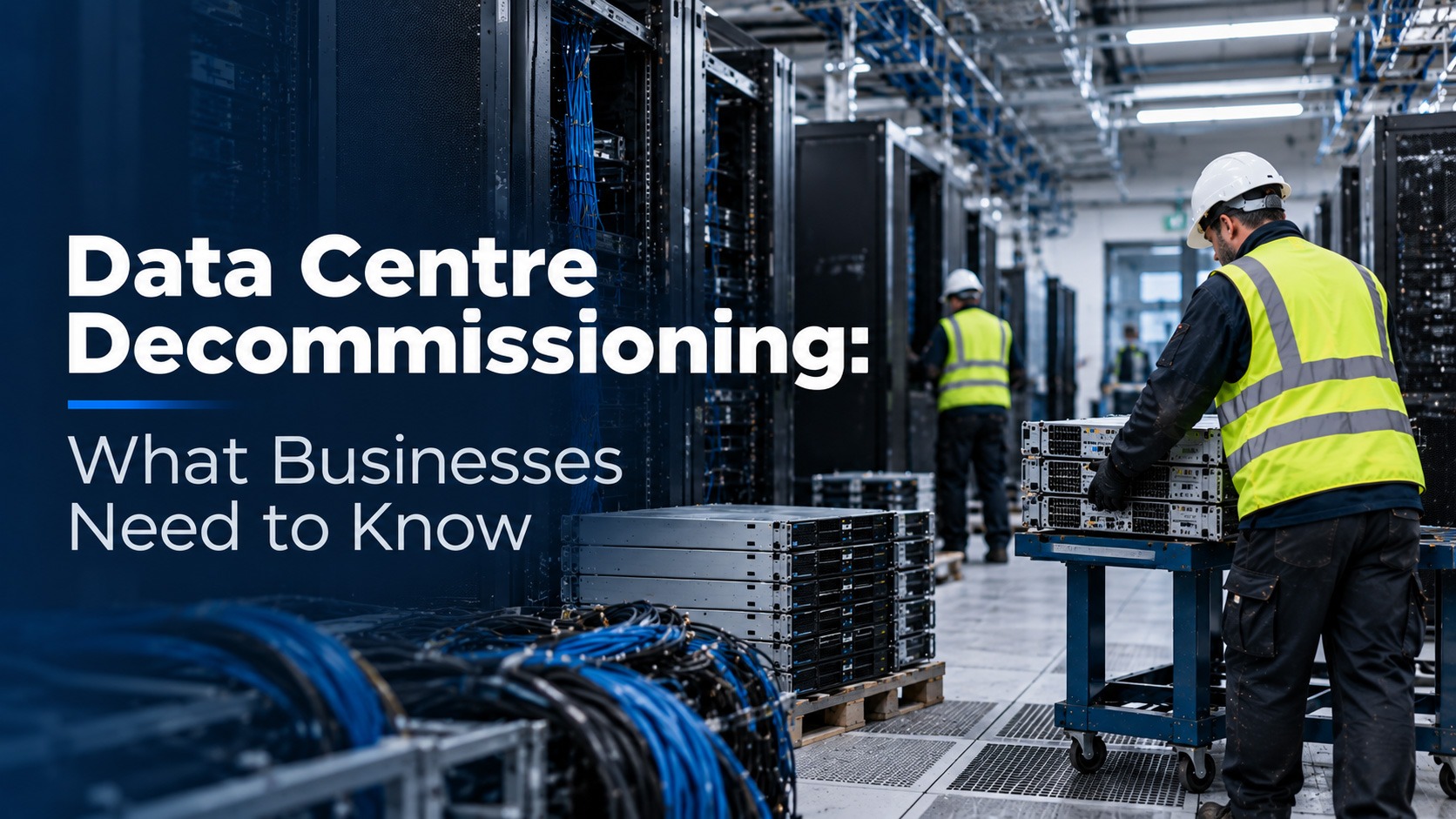
Data centre decommissioning is a complex process involving the planned shutdown, removal and disposal of IT equipment, power infrastructure, cooling systems and other critical site assets.
Whether a facility is being closed, relocated, upgraded or repurposed, decommissioning needs to be carefully planned to protect equipment, minimise disruption and ensure materials are handled appropriately.
For businesses, operators, facilities managers, developers and contractors, the physical removal of infrastructure is only one part of the process. A successful project also needs to consider data security, electrical and mechanical systems, specialist lifting, waste management, recycling and site clearance.
In this guide, we explain what data centre decommissioning involves and the key considerations when preparing a facility for closure or redevelopment.
What Is Data Centre Decommissioning?
Data centre decommissioning is the controlled process of taking a data centre or part of a data centre out of operation and removing its redundant infrastructure.
Depending on the project, this can involve:
- Servers and IT equipment
- Server racks
- Raised access flooring
- Cable trays and containment
- Data cabling
- UPS systems
- Batteries
- Generators
- Transformers
- Switchgear
- Electrical distribution equipment
- CRAC and cooling systems
- Chillers
- HVAC equipment
- Pipework
- Plant room equipment
- Security and access-control equipment
- Internal partitions and fixtures
- Other redundant infrastructure
The scope varies considerably between facilities.
A small server room decommissioning project may involve removing a relatively limited amount of equipment, while a large data centre closure can involve the dismantling and removal of significant quantities of electrical, mechanical and cooling infrastructure.
HIR Ltd provides Data Centre & Energy Plant Decommissioning, Strip Outs & Clearance services across London and the UK, including specialist removal of mechanical and electrical infrastructure, cooling systems, plant and recoverable materials.
Why Do Businesses Decommission Data Centres?
There are several reasons why a data centre may need to be decommissioned.
1. Facility Closure
A business may decide to permanently close an existing data centre because its infrastructure is no longer required.
This can result in a complete decommissioning and site clearance project.
2. Data Centre Relocation
A company may move its IT infrastructure to:
- A new facility
- A colocation provider
- A cloud environment
- Another company-owned data centre
Once the old facility is no longer required, redundant infrastructure can be removed.
3. Technology Upgrades
Older data centre infrastructure may become obsolete as businesses upgrade their IT systems.
This can leave significant quantities of:
- Racking
- Servers
- UPS equipment
- Cooling systems
- Cabling
- Electrical infrastructure
requiring removal.
4. Building Redevelopment
A former data centre may be converted, refurbished or redeveloped for another use.
In these circumstances, the internal infrastructure may need to be stripped out before the next phase of the project.
This can make data centre decommissioning closely connected with commercial strip outs and demolition preparation.
What Does Data Centre Decommissioning Involve?
A typical project can involve several stages.
Stage 1 – Site Assessment
Before physical removal begins, the facility should be assessed to understand:
- What equipment remains
- Which systems are operational
- What infrastructure is being retained
- Access routes
- Equipment weights
- Lifting requirements
- Loading arrangements
- Waste streams
- Site restrictions
- Project programme
Large data centres can contain complex infrastructure distributed across server rooms, plant rooms, electrical rooms and external areas.
A clear scope helps establish how the equipment can be removed safely and efficiently.
Stage 2 – Shutdown and Isolation
Equipment should not simply be dismantled while connected to live systems.
The decommissioning programme needs to establish which systems are being shut down and which services must remain operational during phased works.
This can be particularly important where the facility is being decommissioned in stages rather than closed all at once.
The exact isolation and electrical procedures will depend on the equipment and site.
Stage 3 – IT Equipment Removal
Depending on the project, redundant IT infrastructure may need to be removed from:
- Server rooms
- Data halls
- Network rooms
- Storage areas
This can include:
- Server racks
- Servers
- Network equipment
- Storage systems
- Cabling
- Cable management
- Containment
The handling of IT equipment also needs to take account of data security and whether equipment is being reused, remarketed, securely destroyed or treated as waste.
Stage 4 – Raised Floor Removal
Raised access floors are common in data centre environments.
When a facility is being completely stripped out, the project may require removal of:
- Floor panels
- Pedestals
- Stringers
- Underfloor cable infrastructure
The decision to remove the raised floor will depend on the intended future use of the building.
Stage 5 – Cable and Containment Removal
Data centres can contain substantial quantities of cabling.
Decommissioning may involve removing:
- Data cables
- Power cables
- Cable trays
- Cable ladders
- Containment
- Redundant electrical infrastructure
Cable removal can also generate recoverable metals, making material segregation and recycling an important part of the overall project.
Stage 6 – UPS and Battery Removal
UPS systems are an important component of many data centre facilities.
A decommissioning project may require removal of:
- UPS units
- Battery cabinets
- Battery banks
- Associated cabling
- Distribution equipment
These systems can be heavy and may require specialist handling and lifting arrangements.
The appropriate treatment of batteries and electrical equipment needs to be considered within the project’s waste and compliance arrangements.
Stage 7 – Cooling System Removal
Cooling infrastructure can represent one of the more substantial parts of a data centre decommissioning project.
This may include:
- CRAC units
- CRAH units
- Chillers
- Pumps
- Cooling pipework
- Air handling equipment
- External cooling plant
- Rooftop equipment
HIR Ltd provides specialist A/C & Chiller Disposal and cooling-system removal alongside its data centre decommissioning services.
Where refrigeration systems contain controlled refrigerants, the appropriate recovery and disposal procedures need to be followed.
Stage 8 – Generator and Power Infrastructure Removal
Larger data centres can contain substantial standby power infrastructure.
This may include:
- Diesel generators
- Transformers
- Switchgear
- Distribution boards
- Fuel systems
- Electrical plant
Removing this equipment can require detailed lifting and transport planning.
Large generators, transformers and other plant may require specialist lifting equipment and carefully planned routes from the building.
HIR Ltd specifically lists generators, transformers and heavy plant among the equipment it handles during data centre and energy plant decommissioning projects.
Stage 9 – Plant Room Strip Out
Data centre plant rooms can contain a mixture of mechanical and electrical infrastructure.
A plant room strip out could include removal of:
- Pumps
- Pipework
- Boilers
- HVAC equipment
- Electrical equipment
- Control systems
- Tanks
- Mechanical plant
The scope depends on which systems are being retained and the future use of the facility.
Data Security During Decommissioning
Data security needs to be considered separately from the physical removal of equipment.
Servers, storage devices and networking equipment may contain commercially sensitive or personal information.
Before equipment is removed, the business should establish:
- What data is stored on the equipment
- Whether equipment will be reused
- Whether data needs to be securely erased
- Whether physical destruction is required
- Who is responsible for data sanitisation
- What documentation is required
Equipment does not automatically become waste simply because it is being removed from service. The Environment Agency provides guidance on determining when electrical and electronic equipment becomes WEEE and how it should subsequently be managed.
Important: physical strip out and equipment removal should therefore be coordinated with the organisation’s own data-security and asset-disposal procedures.
What Happens to Old Data Centre Equipment?
Not everything removed from a data centre necessarily needs to become waste.
Depending on condition, ownership and the client’s requirements, equipment may be:
Reused
Equipment that remains suitable for use may be redeployed elsewhere.
Resold
Some assets may retain commercial value and potentially be sold or recovered.
Recycled
Materials such as metals can be separated and sent for recycling.
Disposed of as Waste
Equipment that is no longer suitable for reuse or recovery will require appropriate waste management.
This is why a detailed asset and material assessment can be valuable before dismantling begins.
Data Centre Decommissioning and WEEE
Electrical and electronic equipment removed during a decommissioning project may fall within the scope of Waste Electrical and Electronic Equipment (WEEE) once it meets the relevant definition of waste.
The Environment Agency provides specific guidance on determining when electrical and electronic equipment becomes WEEE, including considerations around reuse and waste status.
Businesses should ensure that the appropriate waste management arrangements are established before electrical equipment is removed.
HIR Ltd’s existing data centre service includes WEEE-compliant electrical disposal as part of its decommissioning and clearance offering.
Recovering Scrap Metal from Data Centres
Data centre decommissioning can generate substantial quantities of recoverable metal.
Potential materials include:
- Copper cable
- Copper pipework
- Steel
- Stainless steel
- Aluminium
- Electrical components
- Machinery
- Plant
Separating materials where practical can reduce mixed waste and increase opportunities for recycling and recovery.
HIR Ltd provides Scrap Metal Recycling alongside its industrial and data centre services, allowing suitable recovered materials to be processed through established recycling routes.
Heavy Lifting During Data Centre Decommissioning
Some data centre equipment cannot simply be carried out of the building.
Examples include:
- Generators
- Transformers
- Chillers
- UPS systems
- Large electrical cabinets
- Cooling plant
- Heavy machinery
The removal strategy may therefore need to consider:
- Equipment dimensions
- Weight
- Door openings
- Loading bays
- Goods lifts
- Structural loading
- Crane access
- Specialist lifting equipment
- Transport
HIR Ltd provides heavy lifting and specialist removal capabilities as part of its wider data centre and energy plant services.
Decommissioning a Live Data Centre
Not every project involves switching off an entire facility at once.
Some data centres need to remain operational while sections are progressively decommissioned.
This requires careful sequencing.
For example:
Operational data hall
↓
Systems safely transferred or isolated
↓
Section decommissioned
↓
Equipment removed
↓
Services and infrastructure stripped out
↓
Area cleared
↓
Next section
HIR Ltd states that it undertakes phased and controlled work in live data centre environments where required, with site-specific planning and safety procedures.
The exact approach will depend on the facility and the operator’s requirements.
Data Centre Decommissioning Safety
Data centres can contain complex electrical, mechanical and refrigerant systems.
There can also be significant manual handling and lifting risks.
Project planning may therefore need to address:
- Electrical isolation
- Mechanical isolation
- Working at height
- Heavy lifting
- Equipment dismantling
- Restricted access
- Fire protection systems
- Refrigerants
- Battery systems
- Waste handling
- Traffic management
HIR Ltd states that its projects are supported by RAMS and experienced operatives, with health and safety and environmental requirements incorporated into project planning.
Data Centre Decommissioning and Site Clearance
Once equipment and infrastructure have been removed, the project may progress into wider site clearance.
This could involve:
- Remaining fixtures
- Redundant building services
- Flooring
- Partitions
- Cabling
- Plant
- Waste materials
- Remaining equipment
If the building is being refurbished, the final scope may effectively become a commercial strip out.
If the building is being demolished, the decommissioning phase may precede wider demolition works.
Data Centre Decommissioning vs Data Centre Strip Out
The two terms are related but can describe different scopes.
Data Centre Strip Out
Generally focuses on removing internal infrastructure and non-structural elements from a data centre.
This could include:
- Racks
- Raised flooring
- Cabling
- Containment
- Fixtures
- Cooling equipment
Data Centre Decommissioning
Can encompass the wider process of taking the facility or systems out of operation, including:
- Shutdown
- Isolation
- Asset removal
- IT equipment handling
- Mechanical and electrical dismantling
- Cooling-system removal
- Waste management
- Recycling
- Site clearance
A decommissioning project can therefore include a substantial strip out as one component of the overall process.
HIR Ltd’s dedicated service combines data centre decommissioning, strip outs and clearance for this reason.
How Long Does Data Centre Decommissioning Take?
There is no standard timeframe.
The duration can depend on:
- Size of the data centre
- Number of racks
- Quantity of equipment
- Number of plant rooms
- Cooling infrastructure
- Power systems
- Access
- Lifting requirements
- Whether the facility remains partially operational
- Data-security requirements
- Waste volumes
- Required completion date
A small server room may be relatively straightforward, while a large facility containing generators, chillers, UPS systems and extensive infrastructure can require a much longer programme.
Planning a Data Centre Decommissioning Project
Businesses should ideally begin planning well before physical removal starts.
A project plan should establish:
1. What Is Being Removed?
Create a clear asset and infrastructure inventory.
2. What Is Being Retained?
Identify systems that must remain operational or stay within the building.
3. What Happens to IT Equipment?
Establish whether equipment is being reused, sold, recycled or disposed of and how data will be handled.
4. How Will Heavy Equipment Be Removed?
Consider lifting equipment, access routes, loading bays and transportation.
5. What Happens to the Materials?
Plan segregation, recycling and appropriate waste management.
6. What Is the Final Condition Required?
Establish whether the building needs:
- Partial clearance
- Complete strip out
- Reinstatement
- Refurbishment preparation
- Full site clearance
- Demolition preparation
Data Centre Decommissioning for Developers and Contractors
Data centre decommissioning is not limited to operators.
Developers and main contractors may require specialist removal contractors when acquiring or redeveloping an existing facility.
The project may involve:
- Existing plant removal
- M&E dismantling
- Internal strip out
- Cooling-system removal
- Heavy lifting
- Scrap metal recovery
- Site clearance
Coordinating these activities through an experienced contractor can help integrate the removal phase into the wider redevelopment programme.
Why Use a Specialist Data Centre Decommissioning Contractor?
Data centres are significantly more complex than a standard commercial office.
A project can involve multiple specialist disciplines at the same time:
- IT equipment removal
- Mechanical dismantling
- Electrical infrastructure
- Cooling systems
- Heavy plant
- Lifting
- Waste management
- Metal recovery
- Internal strip out
HIR Ltd’s existing service covers data centre and energy plant decommissioning, including M&E dismantling, chiller removal, heavy lifting, specialist transport logistics, scrap metal recycling and site clearance.
Data Centre Decommissioning FAQs
What is data centre decommissioning?
Data centre decommissioning is the controlled process of taking a data centre or part of a facility out of operation and removing its redundant IT, mechanical, electrical, cooling and other infrastructure.
What equipment is removed during data centre decommissioning?
Depending on the project, equipment can include servers, racks, cabling, UPS systems, batteries, generators, transformers, chillers, CRAC units, cable containment and other redundant infrastructure.
Can an operational data centre be decommissioned in phases?
Yes. Some facilities require phased decommissioning so that selected areas remain operational while other sections are isolated and cleared.
What happens to old servers?
Depending on the client’s requirements and the condition of the equipment, servers may be reused, resold, securely processed for data removal, recycled or disposed of appropriately.
Is data centre equipment classed as WEEE?
Electrical and electronic equipment can become WEEE when it meets the relevant definition of waste. Whether equipment is waste or remains suitable for reuse needs to be established as part of the project.
Can you remove data centre chillers?
Yes. Specialist cooling equipment such as chillers and CRAC systems can form part of a data centre decommissioning project. Refrigerant recovery and other applicable requirements need to be addressed as part of the removal process.
Can heavy generators and transformers be removed?
Yes. Large generators, transformers and other heavy plant can require specialist dismantling, lifting and transport planning.
Can data centre decommissioning include a complete strip out?
Yes. Where required, decommissioning can incorporate internal strip out and wider site clearance once the operational infrastructure has been removed.
Data Centre Decommissioning Across London and the UK
HIR Ltd provides specialist Data Centre Decommissioning, Strip Outs & Clearance services across London and the UK.
Projects can include:
- Data centre decommissioning
- Server room strip outs
- M&E dismantling
- UPS removal
- Generator removal
- Chiller and HVAC removal
- Raised floor removal
- Cable and containment removal
- Heavy plant removal
- Scrap metal recovery
- WEEE-compliant electrical disposal
- Site clearance
HIR Ltd is based near Heathrow and works with data centre operators, facilities managers, developers and contractors on complex decommissioning and clearance projects.
If you are planning a data centre closure, relocation, refurbishment or infrastructure removal project, contact HIR Ltd to discuss the scope of work.
Call 0208 166 1221 to discuss your project or request a quotation.
Our related services include:
- Commercial & Industrial Dilapidations
- Warehouse Dilapidations
- Commercial Dilapidations
- Industrial Dilapidations
- Office Dilapidations
- End of Lease Strip Outs
- Property Reinstatement Services
- Strip Out Services
- Site & Factory Clearance
📞 Call: 0208 166 1221
📧 Email: info@hirltd.co.uk
📍 Based near Heathrow, operating nationwide – including Slough, Chiswick, Hounslow, Middlesex, Richmond, Wembley, Windsor, Woking, Twickenham and Staines
👉 Call HIR Ltd today on 0208 166 1221 to discuss your project or request a free quotation.
