
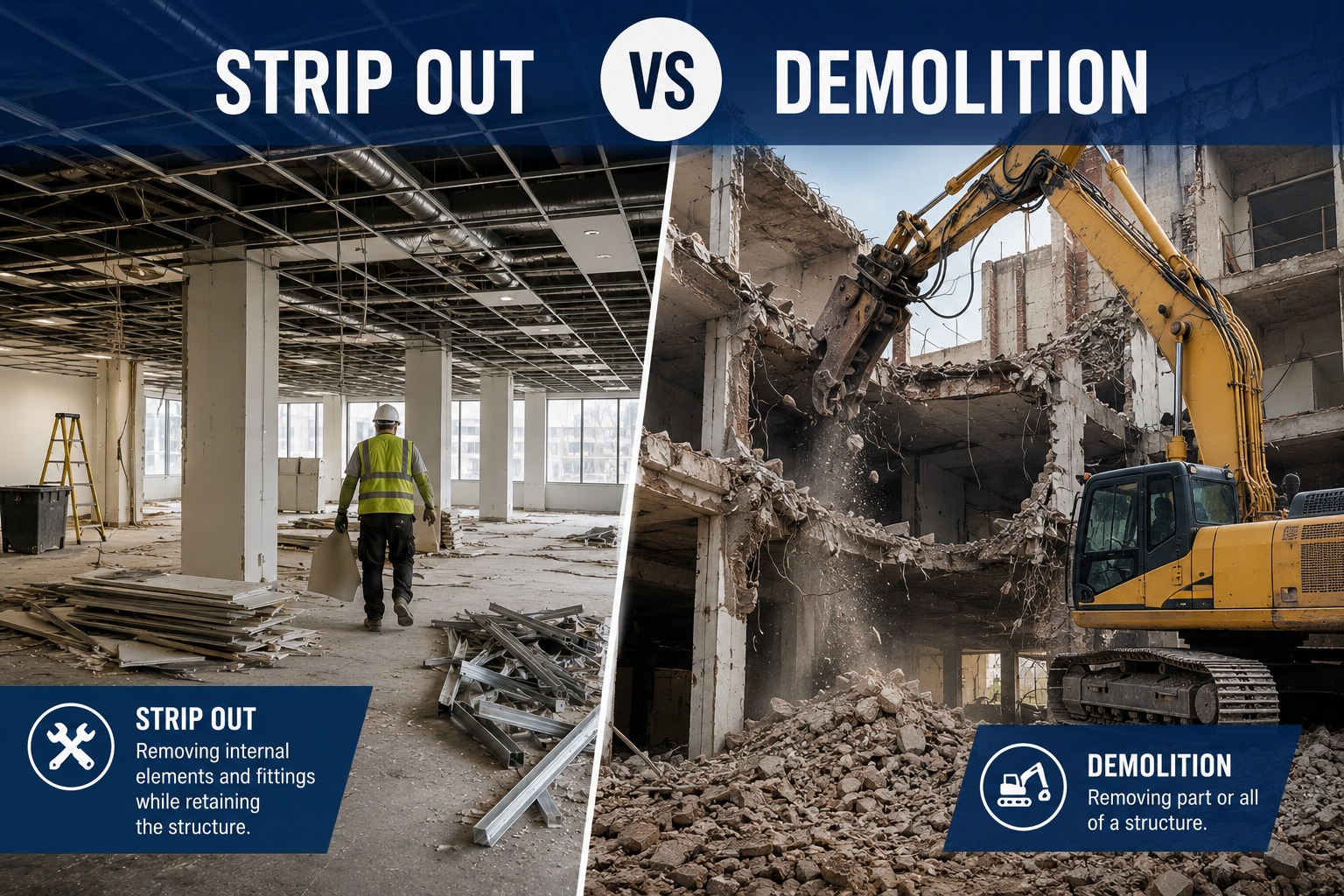
Strip out and demolition are often used interchangeably, but they are not the same type of work. A strip out normally involves removing the internal contents, fixtures, fittings and non-structural elements of a building while retaining the main structure. Demolition, by comparison, involves taking down part or all of the building itself.
Understanding the difference is important when planning a commercial refurbishment, property redevelopment, lease exit or change of use. Choosing the right approach can affect the project programme, cost, waste management and the contractors you need on site.
HIR Ltd provides commercial and industrial strip out, demolition, dismantling and clearance services across London and the South East, supporting landlords, tenants, developers, contractors and property managers.
What Is a Strip Out?
A strip out involves removing selected elements from inside a building while generally retaining the building’s main structural components.
The scope can range from removing fixtures and fittings from a relatively simple commercial unit to completely clearing the internal contents of a large industrial property.
Typical strip out works can include:
- Internal partitions
- Suspended ceilings
- Flooring
- Office furniture and fittings
- Shop fittings
- Counters and displays
- Racking
- Mezzanine structures
- Kitchens
- Sanitaryware
- Lighting
- Electrical accessories
- Data cabling
- Air conditioning
- Ventilation systems
- Machinery and equipment
The objective is usually to leave the building ready for its next stage, such as refurbishment, a new fit-out, redevelopment or lease handover.
Looking for a wider range of strip out services? See our Strip Out Services.
What Is Demolition?
Demolition involves dismantling or bringing down a building, structure or part of a structure.
Unlike a conventional internal strip out, demolition can involve the removal of structural elements such as:
- Walls
- Floors
- Roof structures
- Concrete structures
- Steelwork
- Extensions
- Industrial structures
- Entire buildings
The appropriate demolition method depends on the structure, surrounding environment, access, materials, project requirements and relevant safety considerations.
Demolition can therefore be a considerably more substantial operation than an internal strip out.
Strip Out vs Demolition: The Key Difference
The simplest way to distinguish the two is to consider what is being removed.
| Strip Out | Demolition |
|---|---|
| Primarily removes internal elements | Removes structural elements or buildings |
| Main building structure generally remains | Structure may be partially or completely removed |
| Often prepares a property for refurbishment | Often prepares a site for redevelopment |
| Can involve fixtures, fittings and finishes | Can involve walls, floors, roofs and structural systems |
| Common during commercial fit-outs and lease exits | Common during redevelopment and structural alteration |
| Usually less extensive than full demolition | Can involve complete structural removal |
There can, however, be considerable overlap between the two.
For example, a redevelopment project might begin with an internal strip out before progressing to partial demolition.
What Is a Soft Strip Out?
You may also hear the term soft strip demolition.
Soft stripping involves removing non-structural elements from a building before refurbishment, redevelopment or structural demolition.
This can include:
- Fixtures
- Fittings
- Floor finishes
- Ceiling systems
- Internal partitions
- Doors
- Sanitaryware
- Electrical components
- Mechanical installations
Soft stripping can help separate the removal of internal materials from the later structural demolition phase.
This approach can also make it easier to identify materials for recycling and recovery before structural works begin.
When Is a Strip Out More Appropriate?
A strip out is generally appropriate when the building itself is being retained but its existing interior needs to be removed.
Common examples include:
Commercial Refurbishment
An office building may be structurally sound but have an outdated internal layout.
The existing partitions, flooring, ceilings, lighting and fittings can be removed before the new interior is installed.
Retail Refitting
A retailer may completely change the layout and branding of a store.
A retail strip out can remove existing counters, displays, shelving, flooring, lighting and other installations.
See our dedicated Retail Strip Outs service.
Office Relocation
A company leaving an office may need to remove tenant-installed alterations before handing the property back to its landlord.
This can involve partitions, meeting rooms, kitchens, cabling and built-in fittings.
See Office Strip Outs for more information.
Warehouse Changes
A warehouse may need its existing racking, mezzanines, storage systems or internal offices removed before a new occupier takes over.
See our Warehouse Strip Outs service.
Industrial Clearance
Factories and industrial premises can contain machinery, production equipment, extraction systems and other installations that need to be dismantled and removed.
When Is Demolition Required?
Demolition becomes more relevant when the project involves removing the structure itself.
Examples include:
- Complete building demolition
- Removal of structural extensions
- Demolition of redundant buildings
- Structural alteration
- Partial building demolition
- Redevelopment of an existing site
The project may still begin with a strip out.
For example:
Stage 1: Remove internal fixtures and fittings.
Stage 2: Remove services and non-structural elements.
Stage 3: Demolish the relevant structural elements.
This can be particularly useful when materials need to be separated or recovered before structural demolition begins.
Can a Project Require Both Strip Out and Demolition?
Yes.
In many commercial and industrial projects, strip out and demolition are not alternatives. They are separate stages of the same project.
Consider an old commercial building scheduled for redevelopment.
The contractor may first remove:
- Internal partitions
- Flooring
- Ceilings
- Lighting
- Mechanical systems
- Electrical installations
- Fixtures and fittings
Once the building has been stripped internally, the demolition phase can begin.
This approach can make the overall project easier to manage and can allow different materials to be separated before structural work takes place.
Commercial Strip Outs vs Commercial Demolition
The distinction is particularly important for commercial properties.
A commercial strip out could involve clearing an existing office, retail unit or other business premises while retaining the building.
A commercial demolition project could involve removing the building or significant structural elements.
For businesses planning refurbishment, the first option may be all that is required.
For developers preparing a site for a new building, demolition may ultimately be necessary.
See our Commercial Strip Outs service for more information.
Industrial Strip Outs vs Industrial Demolition
Industrial properties can require more complex removal work because of the equipment and infrastructure they contain.
An industrial strip out could include:
- Production machinery
- Industrial equipment
- Pipework
- Extraction systems
- Electrical systems
- Storage
- Internal structures
- Flooring
- Office areas
If the industrial building itself is being removed, the project may progress into structural demolition.
See our Industrial Strip Outs service.
What About Warehouse Demolition?
Warehouses can present a similar distinction.
A warehouse strip out could involve removing:
- Pallet racking
- Shelving
- Mezzanines
- Conveyor systems
- Internal offices
- Storage structures
- Lighting
- Flooring
The building remains in place.
A warehouse demolition would involve taking down the building or structural elements of it.
This is why establishing the intended end result before work starts is important.
Strip Outs for Commercial Lease Exits
Strip outs are particularly relevant when a commercial lease is coming to an end.
A tenant may have installed alterations during its occupation that need to be removed before the property is handed back.
Examples can include:
- Office partitions
- Shop fittings
- Warehouse racking
- Mezzanine structures
- Built-in furniture
- Signage
- Lighting
- Specialist installations
This type of work can form part of an End of Lease Strip Outs project.
However, a strip out does not automatically mean that all lease obligations have been satisfied.
The tenant may also need to address repairs, making good, redecoration or other reinstatement requirements.
Strip Out vs Dilapidations
Strip out and dilapidations are also frequently confused.
They are related but describe different things.
Strip Out
The physical removal of fixtures, fittings and alterations.
Dilapidations
The lease-related obligations concerning the condition of a commercial property.
Reinstatement
The work required to restore the property where this is required.
For example, a tenant may have installed a partition wall.
The lease may require it to be removed.
The strip out removes the partition.
The resulting damage or alterations may then require reinstatement.
The wider requirement may be identified through a dilapidations process.
This is why strip out contractors can play an important role in commercial lease exits without being the same thing as a dilapidations service.
How Do You Know Which Service You Need?
A useful starting point is to ask three questions.
1. Is the building staying?
If the main building is being retained and only the interior needs clearing, a strip out may be appropriate.
2. Is the structure being removed?
If walls, floors, roofs or other structural elements are being demolished, you may require demolition services.
3. Is this connected to a lease exit?
If you’re leaving a commercial property, the work may form part of an end-of-lease strip out, dilapidations or reinstatement programme.
There can be overlap, so the exact scope should be established before work begins.
What Happens During a Strip Out?
Although every project is different, a typical strip out can involve:
1. Scope Assessment
Identify what needs to be removed and what must remain.
2. Site Planning
Establish access, working areas, programme and waste removal requirements.
3. Service Isolation
Relevant electrical, mechanical or other services are appropriately isolated before removal.
4. Dismantling
Fixtures, fittings, equipment and other agreed items are systematically dismantled.
5. Removal
Materials are taken from the property using the agreed access and removal arrangements.
6. Waste Segregation
Suitable materials can be separated for recycling or recovery.
7. Final Clearance
The agreed areas are left clear for refurbishment, redevelopment, handover or the next contractor.
What Happens During Demolition?
Demolition requires a different level of planning because structural elements may be involved.
Depending on the project, this can include:
- Structural assessment
- Demolition planning
- Service disconnection
- Site segregation
- Controlled dismantling
- Structural demolition
- Material processing
- Waste removal
- Site clearance
The method used depends on the building and project circumstances.
Strip Out, Demolition and Recycling
Both types of project can generate significant quantities of waste and recyclable materials.
Strip outs can produce:
- Steel
- Aluminium
- Copper
- Timber
- Glass
- Flooring
- Ceiling materials
- Electrical equipment
Demolition can generate considerably larger quantities of construction and structural materials.
Where practical, separating materials at source can improve recycling and recovery opportunities.
For projects involving significant quantities of metal, see our Scrap Metal Recycling service.
Why Choosing the Right Contractor Matters
Strip out and demolition projects can involve much more than simply removing unwanted materials.
A suitable contractor needs to understand:
- The project scope
- What must remain
- Access restrictions
- Building requirements
- Service isolation
- Dismantling requirements
- Waste handling
- Recycling opportunities
- Project deadlines
- Coordination with other contractors
This becomes particularly important where a strip out is the first stage of a larger refurbishment or redevelopment programme.
HIR Ltd Strip Out & Demolition Services
HIR Ltd provides commercial and industrial strip out, demolition, dismantling, clearance and specialist removal services across London and the South East.
Our services include:
- Commercial Strip Outs
- Office Strip Outs
- Industrial Strip Outs
- Warehouse Strip Outs
- Retail Strip Outs
- End of Lease Strip Outs
- Commercial Demolition
- Industrial Demolition
- Site & Factory Clearance
- Machinery Removal
- Heavy Lifting
- Scrap Metal Recycling
Whether you are refurbishing an existing commercial property, preparing a building for redevelopment or vacating a leased premises, we can help establish the appropriate removal approach for the project.
Strip Outs vs Demolition FAQs
Is a strip out the same as demolition?
No. A strip out generally removes internal fixtures, fittings, finishes and non-structural elements while retaining the main building. Demolition involves removing structural elements or the building itself.
What is soft strip demolition?
Soft strip demolition involves removing non-structural internal elements before refurbishment, redevelopment or structural demolition.
Can strip out work be carried out before demolition?
Yes. Strip out is often carried out before structural demolition so that internal materials, fixtures and services can be removed first.
Is strip out cheaper than demolition?
Not necessarily. Costs depend on the size of the property, materials being removed, access, labour, waste and project complexity. Strip out and demolition are also different scopes of work, so they should not be compared simply by price.
Can you strip out an office without demolishing the building?
Yes. Office strip outs commonly remove partitions, flooring, ceilings, fixtures and services while retaining the main building structure.
Can retail units be stripped out?
Yes. Retail strip outs can remove shop fittings, counters, displays, shelving, signage, flooring, ceilings and other tenant installations.
Can warehouse racking be removed as part of a strip out?
Yes. Warehouse strip outs can include dismantling and removing racking, shelving, mezzanines and other internal storage infrastructure.
Does a lease exit require a strip out?
Not necessarily. The requirement depends on the lease, alterations made during the tenancy and the condition in which the property must be returned.
Does strip out work form part of dilapidations?
It can. A dilapidation requirement may identify alterations that need to be removed, with the physical removal then carried out as part of a strip out.
Need Strip Out or Demolition Services?
If you’re unsure whether your project requires a strip out, soft strip demolition, structural demolition or a combination of services, HIR Ltd can help establish the appropriate scope.
We work with commercial property owners, tenants, developers, contractors and businesses across London and the South East.
Call 0208 166 1221 to discuss your project or request a quotation.
Our related services include:
- Commercial & Industrial Dilapidations
- Warehouse Dilapidations
- Commercial Dilapidations
- Industrial Dilapidations
- Office Dilapidations
- End of Lease Strip Outs
- Property Reinstatement Services
- Strip Out Services
- Site & Factory Clearance
📞 Call: 0208 166 1221
📧 Email: info@hirltd.co.uk
📍 Based near Heathrow, operating nationwide – including Slough, Chiswick, Hounslow, Middlesex, Richmond, Wembley, Windsor, Woking, Twickenham and Staines
👉 Call HIR Ltd today on 0208 166 1221 to discuss your project or request a free quotation.
