
Quick Summary
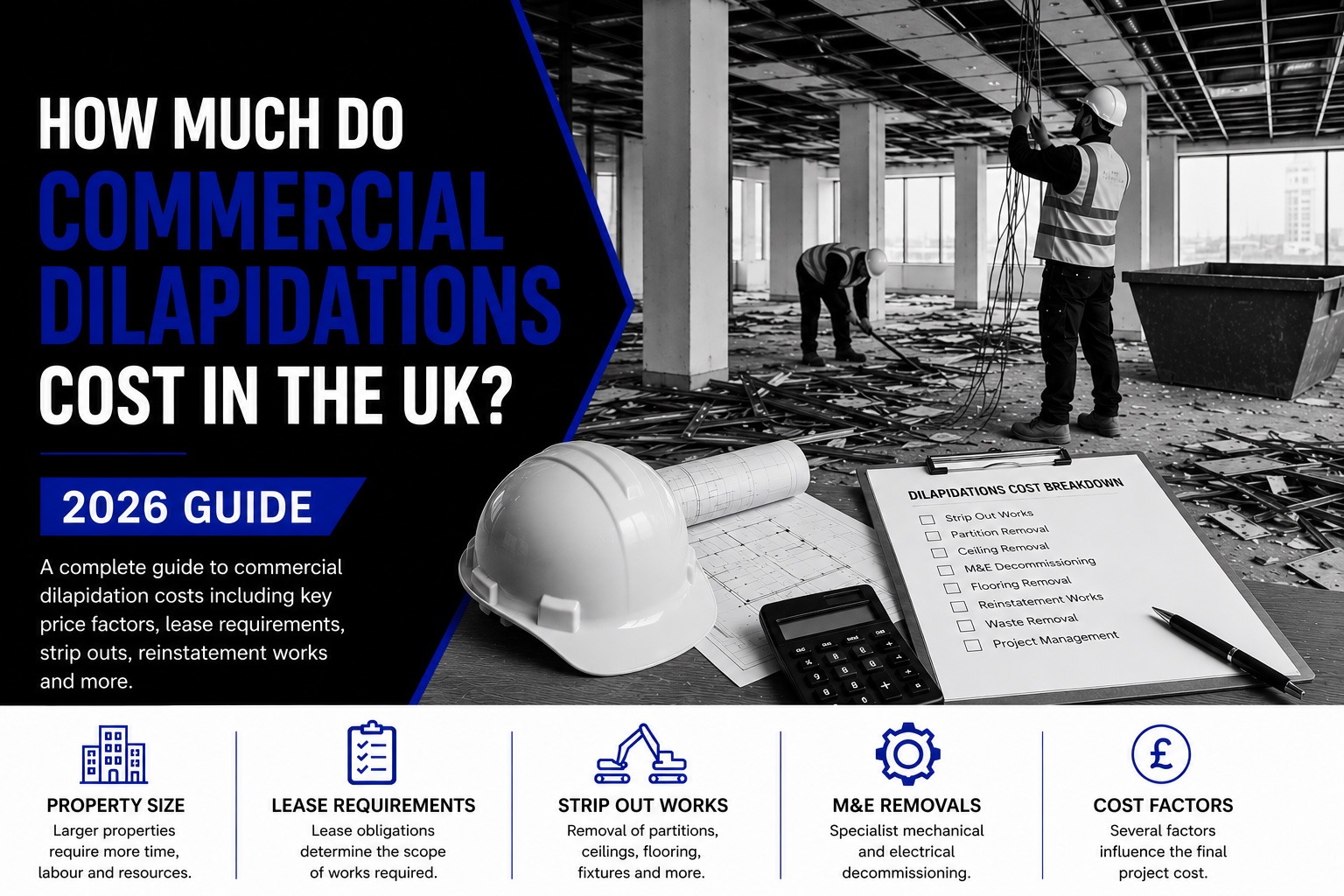
Commercial dilapidation costs depend on the size and condition of the property, the terms of the lease, and the scope of reinstatement works required. Whether you’re vacating an office, warehouse or industrial facility, early planning and professional project management can significantly reduce costs and avoid unnecessary disputes.
How Much Do Commercial Dilapidations Cost?
One of the most common questions landlords and tenants ask before the end of a commercial lease is:
“How much are our dilapidation works likely to cost?”
The answer varies because every property is different. A small office with a few partition walls will require far less work than a warehouse with pallet racking or a manufacturing facility containing heavy machinery and specialist infrastructure.
The best way to understand likely costs is to review the lease agreement, assess the condition of the property and identify any reinstatement works required before handover.
What Affects the Cost of Commercial Dilapidations?
Several factors determine the overall cost of a dilapidation project.
Property Size and Layout
Larger commercial premises naturally require more labour, equipment and project management.
Typical properties include:
- Office buildings
- Retail units
- Industrial units
- Warehouses
- Distribution centres
- Manufacturing facilities
The complexity of the building layout also influences the amount of work required before the property can be returned to the landlord.
Lease Obligations
No two commercial leases are identical.
Some only require cosmetic repairs, while others require complete reinstatement to the property’s original condition.
Typical lease obligations include:
- Wall repairs
- Decorating
- Flooring replacement
- Ceiling repairs
- Removal of tenant alterations
- Making good previous installations
Understanding these obligations early allows businesses to budget accurately and avoid unexpected costs.
Strip Out and Reinstatement Works
Many commercial properties undergo significant alterations during a tenancy. Meeting rooms, kitchens, glass partitions, raised floors and suspended ceilings are commonly installed to suit operational requirements.
Before a lease ends, these additions often need to be removed and the property restored.
Professional Commercial Dilapidations usually combine strip out works with reinstatement, ensuring the building is returned in accordance with lease requirements while reducing the risk of disputes with landlords.
Mechanical and Electrical Installations
Modern commercial buildings often contain additional services installed by the tenant.
These may include:
- Air conditioning
- Ventilation systems
- Electrical distribution
- Security systems
- Data cabling
- Fire alarms
Removing and safely decommissioning these systems requires specialist expertise, particularly where refrigerants or complex electrical infrastructure are involved. Integrating these works into a wider Commercial & Industrial Dilapidations project helps streamline the programme and reduce unnecessary contractor costs.
Industrial Facilities
Factories and manufacturing sites usually involve a far more complex scope of work than traditional commercial buildings.
Production lines, compressors, pumps, boilers and heavy process equipment often need dismantling before reinstatement can begin.
Projects involving Industrial Dilapidations generally require specialist lifting equipment, experienced engineers and detailed project planning to ensure equipment is removed safely without damaging the surrounding structure.
Warehouse Projects
Warehouse properties have their own unique requirements.
Unlike offices, many warehouses contain:
- Pallet racking
- Mezzanine floors
- Loading bays
- Warehouse offices
- Conveyor systems
- Storage infrastructure
A dedicated Warehouse Dilapidations programme ensures these specialist installations are dismantled safely while restoring the building for future occupation.
Can You Reduce Dilapidation Costs?
Absolutely.
The biggest mistake businesses make is waiting until the final weeks of a lease before organising contractors.
Planning several months in advance provides time to:
- Review lease obligations
- Obtain competitive quotations
- Schedule works efficiently
- Coordinate multiple trades
- Minimise disruption to business operations
Early planning often results in lower overall project costs and a smoother handover.
Why Using One Contractor Saves Money
Many dilapidation projects involve several different disciplines.
These may include:
- Strip out works
- Building repairs
- Mechanical and electrical removal
- Heavy machinery removal
- Waste disposal
- Site clearance
- Final reinstatement
Managing these services through multiple contractors can create delays, duplicated costs and communication issues.
Using a single experienced contractor simplifies project management, improves health and safety coordination and often reduces the total cost of the project.
Why Choose HIR Ltd?
HIR Ltd has over 30 years of experience delivering commercial and industrial property reinstatement projects throughout London and the South East.
We work with landlords, tenants, developers, surveyors and facilities management companies to deliver fully managed dilapidation solutions that include strip outs, reinstatement, machinery removal, waste clearance and property restoration.
Every project is carefully planned to help clients satisfy lease obligations while minimising downtime and unexpected costs.
Commercial Dilapidation Costs FAQs
Can you estimate commercial dilapidation costs without visiting the property?
An initial estimate may be possible, but an on-site survey provides the most accurate quotation because every property and lease agreement is different.
Are warehouse dilapidations more expensive than office dilapidations?
They often are. Warehouses frequently contain racking systems, mezzanines and specialist infrastructure that require additional dismantling and reinstatement work.
Do industrial properties require specialist contractors?
Yes. Industrial sites often contain heavy machinery, mechanical services and production equipment that require experienced contractors with specialist lifting and dismantling capabilities.
When should dilapidation works begin?
Ideally, businesses should begin planning three to six months before lease expiry to allow sufficient time for surveys, quotations and project scheduling.
Need Professional Dilapidation Contractors?
Whether you’re vacating a commercial office, warehouse, factory or industrial facility, HIR Ltd provides complete end-of-lease reinstatement services across London and the South East.
Our specialist services include:
- Commercial & Industrial Dilapidations
- Commercial Dilapidations
- Industrial Dilapidations
- Warehouse Dilapidations
- Office Dilapidations
- End of Lease Strip Outs
- Lease Exit Reinstatement
- Strip Out Services
- Site & Factory Clearance
To find out more about property reinstatment services – please read our guide.
HIR Ltd supports dilapidation projects across:
Our experienced teams manage every stage of the project, from initial strip out works and machinery removal through to reinstatement, waste clearance and final handover.
📞 Call: 0208 166 1221
📧 Email: info@hirltd.co.uk
📍 Based near Heathrow, operating nationwide – including Slough, Chiswick, Hounslow, Middlesex, Richmond, Wembley, Windsor, Woking, Twickenham and Staines
👉 Call HIR Ltd today on 0208 166 1221 to discuss your project or request a free quotation.
