
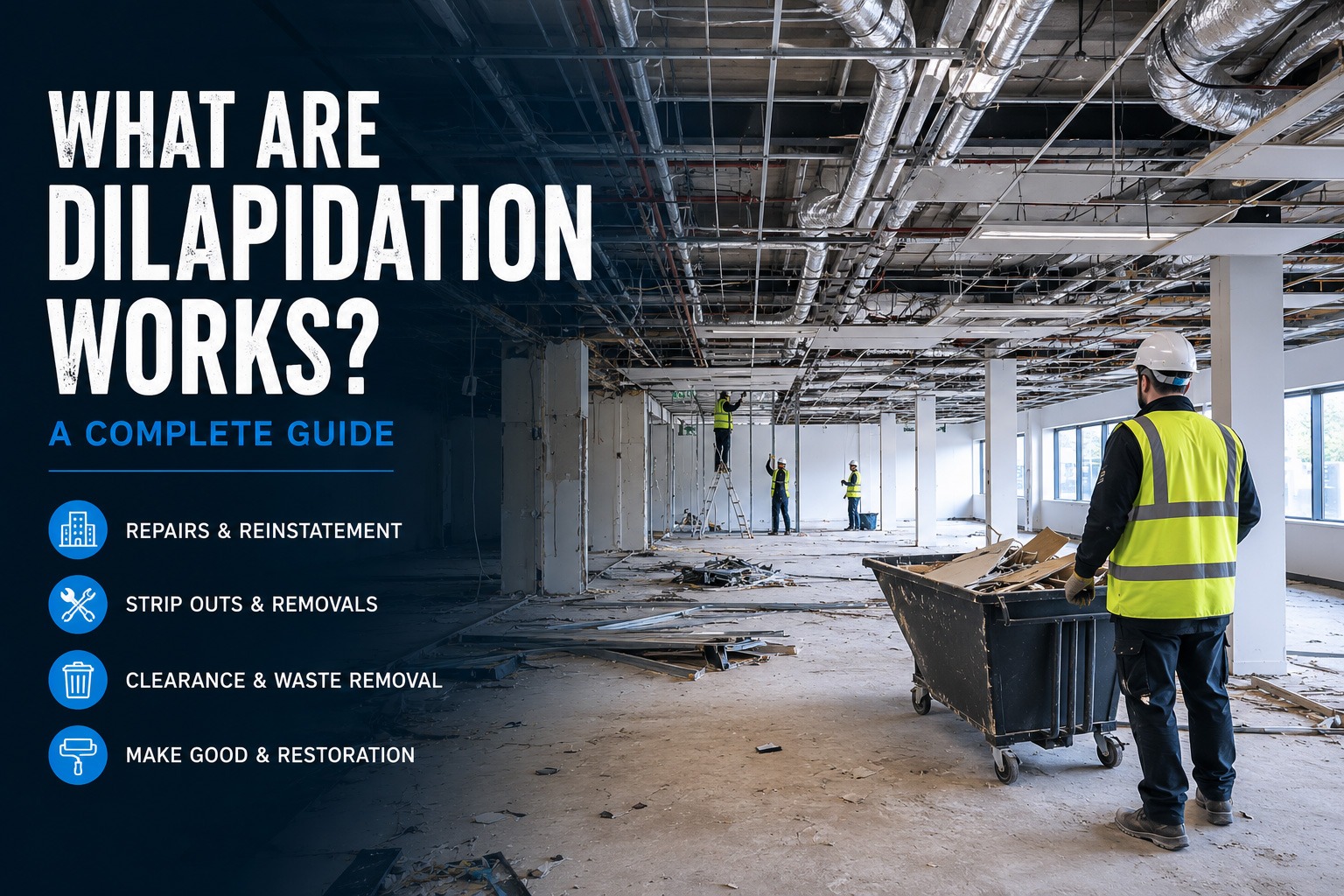
Quick Summary
Dilapidation works are repairs, reinstatement works, strip outs, and property restoration activities required to return a commercial property to the condition agreed within a lease. They are commonly required at the end of commercial leases for offices, warehouses, industrial units, retail premises, and commercial buildings.
What Are Dilapidation Works?
Dilapidation works involve restoring, repairing, removing, or reinstating parts of a property to meet lease obligations.
These works commonly happen when:
- Commercial leases end
- Businesses relocate
- Properties undergo refurbishment
- Buildings are prepared for new tenants
- Landlords require reinstatement works
Typical dilapidation projects involve:
- Internal strip outs
- Repairs and reinstatement
- Removal of tenant alterations
- Ceiling and partition removal
- Mechanical and electrical removals
- Decorating and making good
Why Are Dilapidation Works Important?
Commercial leases often require tenants to return premises to an agreed condition.
Failure to complete dilapidations can lead to:
- Financial disputes
- Lease penalties
- Delayed property handovers
- Legal claims
- Increased landlord costs
Proper planning reduces risks and unexpected costs.
What Types of Buildings Require Dilapidation Works?
Dilapidations are common across:
Office Buildings
- Partition removal
- Raised flooring removal
- Ceiling strip outs
- M&E removals
Warehouses & Industrial Units
- Machinery removal
- Plant room dismantling
- Warehouse clearance
- Infrastructure strip outs
Retail Units
- Shop fitting removal
- Signage removal
- Flooring replacement
Commercial Properties
- Internal demolition
- Building reinstatement
- Waste removal
What Is Included in Dilapidation Works?
1. Strip Out Works
Many projects start with removing tenant-installed items.
This may include:
- Partition walls
- Ceilings
- Flooring systems
- Fixtures and fittings
- M&E systems
2. Reinstatement Works
Reinstatement returns the property to its original or lease-agreed condition.
Examples include:
- Rebuilding walls
- Decorating
- Flooring replacement
- Making good damaged areas
- Restoring layouts
3. Mechanical & Electrical Removal
Many commercial tenants install additional infrastructure.
This often requires removal of:
- HVAC systems
- Electrical installations
- Air conditioning systems
- Data cabling
- Plant equipment
4. Clearance & Waste Removal
After dismantling works are complete, sites typically require:
- Waste removal
- Site clearance
- Recycling services
- Final clean downs
End of Lease Dilapidations Explained
End-of-lease dilapidations are among the most common commercial projects.
This process often includes:
- Lease review
- Site survey
- Dilapidation schedule review
- Removal and reinstatement works
- Clearance and handover
Businesses that prepare early generally reduce costs.
Who Pays for Dilapidation Works?
Responsibility depends on lease terms.
Typically:
Tenants May Pay For:
- Damage repairs
- Reinstatement works
- Removal of alterations
- Decorating obligations
Landlords May Cover:
- Structural issues
- Certain pre-existing defects
- Agreed redevelopment works
Professional advice should always be sought when reviewing lease obligations.
Common Dilapidation Mistakes
Businesses often face higher costs because of:
- Leaving works too late
- Misunderstanding lease obligations
- Incomplete strip outs
- Poor contractor coordination
- Ignoring reinstatement requirements
Early planning usually reduces risk.
Dilapidation Works for Warehouses & Industrial Units
Industrial dilapidation projects often involve:
- Heavy machinery removal
- Plant room dismantling
- Warehouse strip outs
- Factory clearance
- Infrastructure removals
These projects typically require specialist contractors.
Dilapidation Contractors Across London & The UK
HIR Ltd supports dilapidation projects across:
We deliver safe and compliant commercial property reinstatement services.
Dilapidation Works FAQs
What are dilapidation works?
Dilapidation works are repairs, strip outs, reinstatement works, and restoration activities completed to meet commercial lease obligations.
When are dilapidation works required?
They are commonly required at lease end, during relocations, or before redevelopment projects.
Who pays for dilapidations?
This depends on lease agreements, although tenants are often responsible for reinstatement obligations.
Are dilapidations only for offices?
No – warehouses, industrial units, retail spaces, and commercial buildings frequently require dilapidation works.
Why Choose HIR Ltd?
HIR Ltd has over 30 years of experience delivering:
- Commercial strip outs
- Site clearance
- Infrastructure dismantling
- Heavy machinery removal
- Reinstatement works
We provide safe, reliable, and compliant solutions for commercial property projects.
Get a Quote
If you require dilapidation works, strip outs, or commercial reinstatement services, contact HIR Ltd today.
📞 Call: 0208 166 1221
📧 Email: info@hirltd.co.uk
📍 Based near Heathrow, operating nationwide – including Slough, Chiswick, Hounslow, Middlesex, Richmond, Wembley, Windsor, Woking, Twickenham and Staines
👉 Contact us today for a fast, safe, and compliant solution.
